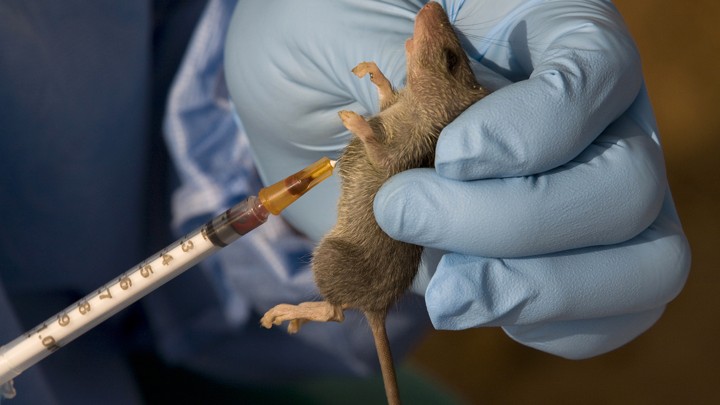
An ecologist extracts a sample of blood from a Mastomys Natalensis rodent in the village of Jormu in southeastern Sierra Leone February 8, 2011. Lassa fever, named after the Nigerian town where it was first identified in 1969, is among a U.S. list of "category A" diseases -- deemed to have the potential for major public health impact -- alongside anthrax and botulism. The disease is carried by the Mastomys Natalensis rodent, found across sub-Saharan Africa and often eaten as a source of protein. It infects an estimated 300,000-500,000 people each year, and kills about 5,000. Picture taken February 8, 2011. To match Reuters-Feature BIOTERROR-AFRICA/ REUTERS/Simon Akam (SIERRA LEONE - Tags: HEALTH SOCIETY ANIMALS) - GM1E72F07HC01
Aug. 17, 2025
Nigeria has joined a new 6.4 million dollar international research consortium aimed at accelerating the development of a vaccine against Lassa fever.
This was made known in a statement by the Coalition for Epidemic Preparedness Innovations (CEPI) on Sunday.
The initiative, tagged Unravelling Natural and Vaccine-Elicited Immunity to Lassa fever (UNVEIL), is led by the University of Texas Medical Branch (UTMB), with funding support from CEPI.
They will work alongside the Kenema Government Hospital in Sierra Leone.
The research will focus on identifying immune markers or correlates of protection, biological signatures in blood or cells that indicate immunity to Lassa fever.
Experts said that the breakthrough could enable vaccine makers to measure protection through laboratory tests rather than lengthy clinical trials, thereby fast-tracking vaccine delivery to affected communities.
Dr. Courtney Woolsey, Principal Investigator of the UNVEIL programme, said that the project would help remove a “huge roadblock” in vaccine development.
“Once we can measure protection in a blood test instead of a prolonged clinical efficacy trial, we can deliver vaccines to impacted communities much faster,” Woolsey said.
Lassa fever infects an estimated 100,000 to 300,000 people annually.
Case fatality rates can exceed 20 per cent among hospitalised patients, while survivors face complications such as irreversible hearing loss.
Studies also showed that 95 per cent of pregnancies in infected women result in miscarriage.
Dr. Katrin Ramsauer, CEPI’s Lassa Disease Programme Lead, described the research as a milestone.
“A vaccine is urgently needed against Lassa fever, a deadly disease that continues to burden West Africa.
“Knowing the immune markers that correspond to protection will be a milestone achievement in our work against Lassa fever,” Ramsauer said.
The consortium would also build capacity in African partner hospitals through training in diagnostics, biobanking and clinical research, strengthening regional outbreak response and health security.
Experts believed the methods pioneered for Lassa fever could be rapidly adapted for other hemorrhagic fevers, such as Ebola, boosting global pandemic preparedness.
UNVEIL brings together scientists from the United States, the United Kingdom, Nigeria, and Sierra Leone in the fields of virology, immunology, bioinformatics, and clinical care.
The project’s “Team Science” approach reflects international commitment to tackling infectious diseases that disproportionately affect Africa. (NAN)