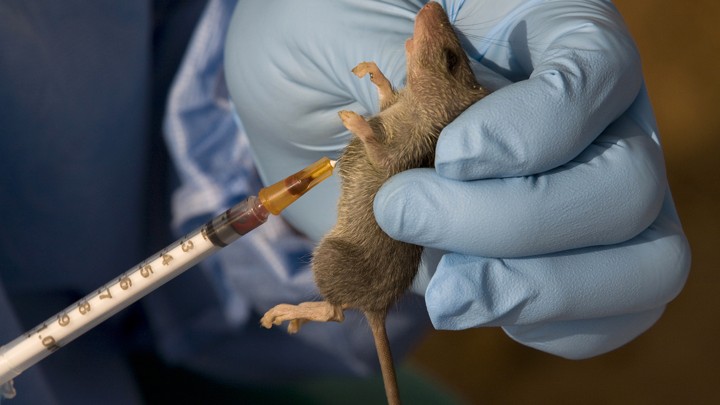
An ecologist extracts a sample of blood from a Mastomys Natalensis rodent in the village of Jormu in southeastern Sierra Leone February 8, 2011. Lassa fever, named after the Nigerian town where it was first identified in 1969, is among a U.S. list of "category A" diseases -- deemed to have the potential for major public health impact -- alongside anthrax and botulism. The disease is carried by the Mastomys Natalensis rodent, found across sub-Saharan Africa and often eaten as a source of protein. It infects an estimated 300,000-500,000 people each year, and kills about 5,000. Picture taken February 8, 2011. To match Reuters-Feature BIOTERROR-AFRICA/ REUTERS/Simon Akam (SIERRA LEONE - Tags: HEALTH SOCIETY ANIMALS) - GM1E72F07HC01
February 3, 2023
Kogi has recorded six cases of Lassa fever, the Director of Disease Control in the state’s Ministry of Health, Dr. Austin Ojotule, said in Lokoja on Friday.
“As it is now, we are battling with six cases of Lassa fever in the state, but the situation is under control, he told the News Agency of Nigeria (NAN).
“The good thing about it is that we have not recorded any death and we are treating the affected persons and preventing further spread of the disease.
“When there is an outbreak, samples are taken by Disease Surveillance Officers in the local government areas and sent the ministry for analyses to enable us to effectively and efficiently control the disease,’’ he explained.
He said each of the 21 local government areas of the state has primary healthcare facilities and enough personnel to handle cases of heat-related illnesses.
There are also tertiary health institutions in Lokoja and in Anyigba, and zonal hospitals in each of the three senatorial districts of the state that could conveniently treat diseases, he added.
He also told NAN that government had put machinery in place to deal with the outbreak of heat-related diseases such as meningitis, cholera, measles, diphtheria and Lassa fever among others.
He added that the ministry was on a vigorous sensitisation of the public on the need to watch out and to be conscious of their environment and to report any sign or symptoms of diseases to the nearest hospital promptly.
Ojotule advised residents to take their personal and environmental hygiene serious to avoid disease outbreak. (NAN)