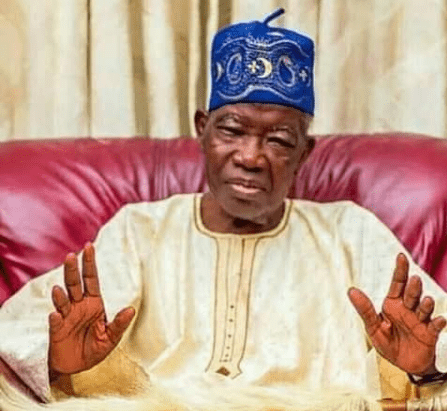
The late Lateef Jakande
Jakande, who had been a journalist, as far back as the 1940s – well before about 98 percent of the audience were born – deserved to be honoured by the Lagos and federal governments for his many feats in exemplary leadership
It was in his name that the Nigerian Guild of Editors (NGE) gathered, recently in Lagos. The fourth in a series, so far, of public lectures, in honour of the first democratically elected governor of Lagos State – Alhaji Lateef Kayode Jakande – was an occasion on which Gbemiga Ogunleye, a lawyer and former provost of the Nigerian Institute of Journalism, Ogba, Lagos, and one other, made a case that Jakande was well deserving of an honour by the Lagos State and federal governments.
In agreement, Professor Sylvester Odion Akhaine, of Lagos State University, Ojo, emphasized a thought-provoking point that was more of a challenge to Nigerian journalists. His submission was freighted on the fact that Jakande, who’s, perhaps, the best governor and only seasoned journalist to have governed Lagos State, had reliable allies, in the NGE and Nigeria Union of Journalists, who’re well-positioned and armed with all that it’d take, especially the pen, to see that Jakande would be crowned, meritoriously, at state and national levels. Posthumously. And, in blowing the journalistic trumpet that Jakande should be honoured, any time hence, there should be less of modesty. It’s just human.
Jakande, who had been a journalist, as far back as the 1940s – well before about 98 percent of the audience were born – deserved to be honoured by the Lagos and federal governments for his many feats in exemplary leadership. All that were richly expressed in Jakande establishing the first state-owned university in the country, in the interest of the children of the poor; free education that, as an apostle of the late sage – Chief Obafemi Awolowo – he pressed, with an utmost vigour of an Olympic sprint champion and, amongst others, construction of affordable houses, in estates, in different parts of the state, for low income workers. Those feats, by selfless Jakande, have not been surpassed – indeed, it’s far from certain that they would, in the next seven decades – more than forty years, since he left office, on December31, 1983.
In response to a call that the Lagos State University should be an eponymous Jakande institution, Akhaine said that the duty to that effect was that of the visitor to the university – in the person of Governor Babajide Sanwo-Olu, who was represented on the occasion by Gbenga Omotoso, an award-winning journalist and Commissioner for Information and Strategy. The tacit challenge thrown at the NGE, by Akhaine, who was the guest lecturer, was that the body should be about mounting unceasing pressure on the Sanwo-Olu administration to that effect.
While some may have contended that, as someone who lived a clearly spartanly life, and never travelled out of the country between 1979 and 1983, when he was in office, for whatever reason, and amongst others, never had a fleet of posh cars, Jakande was the only one who, therefore, could explain why he never named the university that he established after himself. LKJ, as he was admirably called by his swarming supporters, thought otherwise, this writer thinks, because of his belief in the Awoist philosophy of selfless service, as the first aspect of good leadership.
This was more so, as Akhaine said, repeatedly, especially when it concerned the individual and the public, in a voting political process, that mirrors the “contestation of power.” It was that political process that produced Jakande as a decent, selfless governor under the banner of the Unity Party of Nigeria (U.P.N.). Still, the Jakande case of clearly of visible, unrivalled, people-oriented achievements, made it seem as though the opposition never existed. Selfless service and an open-door policy made it easy for Jakande to be the darling of the voters in Lagos State. It’s for that – and many more besides – that Jakande’s is a cherished memory.
Where are the shameless, unclean politicians, of whom Nikita Khrushchev – the third president of the Union of Soviet Socialist Republics (US.S.R.) – said were unrepentant liars, who’d promise to build a bridge where there’s no river? Where are they? Which one of them can erase the glowing good leadership record set by Jakande?
It, really, was for Jakande’s brilliant performance that Lagos State, now, rightly, has the slogan “Centre of Excellence.” For Jakande’s peerless achievements, it’s, hereby, decreed that future governors of Lagos State must be journalists. Omotoso, next? The president of the Federal Republic of Nigeria, too. Dele Alake, Tunji Bello, or Segun Ayobolu, next? If only to put an end to corruption and the flagitious misuse of public funds. With the Jakande’s spirit of purposive, good leadership, in all aspects of public life, Nigeria would rival such ex-Asian Tigers as Singapore, South Korea and Taiwan.
The Jakande phenomenon – in and out of office, and in death – remains a compelling reference point for researchers and commentators on progressive public administration – that was clearly defined by transparency and prudent use of public funds. If he were alive today, Jakande, would have long served, again, as governor – not, necessarily, because ‘one good term deserves another’, as some empty politicians are known to parrot, but for all his visible Olympian feats. Yes, for that, he would have had less need to spend, on the campaign trail, his own funds, but millions of Naira donated by his friends or faceless admirers – call it crowd funds, if you care. In that case, it’s almost certain that Jakande would have had no challenger. He would have been returned unopposed.
It’s on record that Jakande was a king-maker with a swarming population of followers in need of his blessing as they went into Lagos politics as debutants. Were Jakande a former governor, in the Fourth Republic, he would have rejected the utterly obscene post-governorship benefits as enshrined in the 1999 Constitution, in Section 124, which includes “a life pension matching 100 percent of an incumbents basic salary, furnished residential properties in their state and Abuja, regularly replaced luxury vehicles, free medical care and heavy security.” Again, because of his unblinking belief in the Awoist frugal life style, Jakande would have campaigned against it; that none of the democratically elected governors of Lagos State – if not all the governors in the South West geopolitical zone – should accept the extremely unjust offer.
All that would have sounded, appealingly, like a peremptory commandment by Jakande. He, probably, would have lobbied the Lagos State House of Assembly, besides, to legislate to that effect. Yes, opposition, by those who prefer to live a life of unmerited luxury, at the expense of those who had, some years ago, voted him into office, would have come Jakande’s way, but bootless would it, for certain, have been. Akhaine submitted that Jakande was a manifestation of a good choice, in an exercise of the contestation of power, by an enlightened class of voters, who were athirst of a free political space via a termination of a brutish stratocracy.
By extension, there’s a pressing need for the same class of enlightened voters to elect individuals – men and women, in municipal elections – as their deputies at the three tiers government. Such men and women, Akhaine said, in his belief in Solon – the dour-looking lawgiver of Athens, in ancient Greece, the birthplace of democracy – should realize that power was never served a la carte. For its foremost profile, as a political elements, in an organized political space, it requires a persuasively independent body as an umpire – in a vivacious contestation for it by candidates of political parties. Independents, too.
Beyond mediation and voters participation, in such a contest, it was the submission of Akhaine – a political scientist and specialist in demilitarization and constitutionalism, in a post-military nation-state that is preparing herself for multi-party democracy – that the skipper of the umpire body should be elected by the parliament; in Nigeria’s case the National Assembly, which comprises the House of Representatives and the Senate. Not, as he offered, the executive.
The role of parliament – especially in a liberal, free-enterprise democracy, as in the United States of America – is to ensure that, with a competent, neutral head, the umpire body of a voting exercise, which he’d supervise, turns out an approximation of a final result – with a finality that would make, less necessary, a post-poll contestation of the results, which, in the Nigerian milieu, could be extremely violent, as horribly demonstrated by Operation Weti e, in the early 1960s and the Ajasin-Omoboriowo vendetta in Ondo State, in the early 1980s.
As the 2027 elections draw near, it was the opinion of Akhaine – on an occasion that was that was graced by Jakande’s widow, Alhaja Sikitat Abimbola and members of her family, Lai Olurode, retired professor of sociology, University of Lagos, Akoka and former national electoral commissioner of the Independent National Electoral Commission (INEC), Sam Amuka, veteran journalist and founder of Vanguard newspapers, and veteran journalist Ray Ekpu, the only surviving member of the Dele Giwa-led qurtet that founded Newswatch magazine – that INEC should distant itself from having an Ahmad or Lawan, declared by the courts as the winner of an election that they never participated in. Between the Supreme Court there ought, in the interest of democracy, to the some fixed peace – defined by the absence of election-related cases. It’s only a truly clean INEC and impartial court, as Akhaine put it, that can be generous enough to crown the Nigerian electoral process thus.
And that, according to Eze Anaba the seventeenth president of NGE and sixth editor of Vanguard newspaper, is an assuring exquisite prerequisite to hold, in a firm leash rascally, bushy-haired Wole Soyinka from holding NEC in solitary confinement, so that it does not announce election results that would trigger off riots; sanguinary riots – a la Ajasin-Omoboriowo that would shatter the peace of the country! And, so, a costly invitation of the rifle – to the termination of the termination of the Forth Republic, which Soyinka fought, valiantly, for in snowy Norway? Jakande to the rescue?