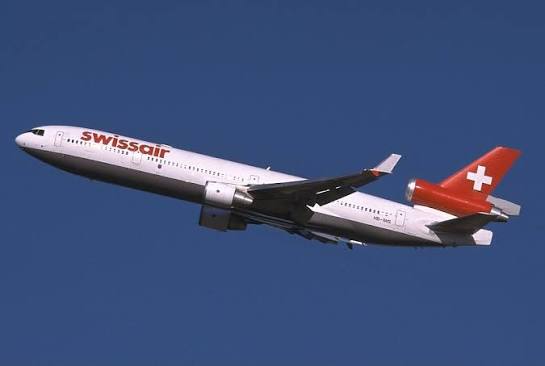
Swissair nosing up the sky
“For financial reasons, Swissair is no longer able to operate its flights.” Exactly 25 years ago, on October 2, 2001, this public address announcement was all it took to announce the obituary of what was once a viable business empire.
Twenty-five years ago, this year, what was ranked as one of the best international airlines, Swissair, hit the bricks and via a public address announcement the world was shocked to hear that the luxury airline has gone dead, business-wise.
“For financial reasons, Swissair is no longer able to operate its flights.” Exactly 25 years ago, on October 2, 2001, this public address announcement was all it took to announce the obituary of what was once a viable business empire.
Reason? The company was broke and could no longer fulfill its financial and flying obligations. On this day of the shocking announcement, a Tuesday, several thousand passengers had already been waiting at Kloten Airport for hours. Across the world, a total of around 20,000 travellers were waiting for their flights, many of whom had already checked in their luggage.
However, for hours, the display board showed only “delayed” for all Swissair flights. At 3:45pm, Swissair finally informed the media – via fax – that it would be suspending flight operations with immediate effect. It had been unable to purchase any more fuel, meaning that its 260 aircraft had to remain grounded. At 4:17pm, an airport employee finally announced over the public address system that the airline, once the pride of the nation, had been grounded.
Strategy gone wrong?
Swissair fall started when voters rejected membership of the European Economic Area (EEA) in 1992. This decision led to the blockade of a bilateral air transport agreement between Switzerland and the European Union. This denied Swissair free access to the European market which accounted for a huge chunk of its business. Note that Swissair had a reputation of acquiring new airliners.
The then CEO, Philippe Bruggisser, had a goal of acquiring as many small airlines as possible in order to bring Swissair to a critical mass and overawe the problem of lack of market access. From 1997 onwards, this aggressive acquisition strategy was officially known as the “Hunter Strategy”.
But this strategy failed because the acquired airlines, including the Belgian Sabena and the Italian Volare, were not only small, they were also unprofitable. The Hunter failed in his hunt for games this time.
CEO Bruggisser was forced to step down. In early 2001, Crossair owner Moritz Suter took the helm for a short time. Following the resignation of the entire board of directors, led by its chairman Eric Honegger, Mario Corti, then Nestlé’s chief financial officer, took over.
‘Swissair Souvenirs’
Corti came under pressure, above all from Swissair’s principal bank, UBS, under the leadership of Marcel Ospel. Corti would later hold Ospel responsible for the grounding. “Super-Mario”, as he was known in the media at the time, did attempt to keep the airline in the air with the help of the government and by setting up a rescue company under the Crossair umbrella.
On September 29, however, the government refused to grant a financial guarantee. On October 1, Crossair, under the leadership of André Dosé, finally took over Swissair’s flight operations. The operating companies SAirGroup, SAirLines and Flightlease were placed under debt restructuring proceedings.
The final fall
But this rescue came too late. On October 2, the grounding took place, which was intended to persuade the government and the banks to reconsider their position.
Reduced operations resumed the very next day thanks to an emergency loan. On April 1, 2002, however, the last Swissair scheduled flight from São Paulo landed in Zurich at 7:15am. With that, the name Swissair came to an end after 71 years of history. It was the biggest corporate collapse in Swiss history. Legally, no one was held to account: all 19 former managers and board members who had been charged were acquitted. The financial settlement was only finalised December 2025 – 24 years after the grounding – with the removal of the holding company SAirGroup from the commercial register.
Lesson for investors
One lesson here is that the best of strategy can fail. Do not invest just for the sake of expansion. Mopping up smaller businesses at their struggling stages can stack up liabilities rather than add to your assets. Swissair bit far more than it could chew and its centre could not hold.
Reporting by Ray Umukoro with additional reports from Swissinfo