pig
March 27, 2024
Some of the deadliest diseases to stalk humankind have come from pathogens that jumped from animals to people. The virus that causes AIDS, for example, crossed over from chimpanzees. And many experts believe the virus that caused the COVID-19 pandemic flowed from bats.
But, as a new study shows, this exchange has not been a one-way street. An analysis of all the publicly available viral genome sequences yielded a surprising result: humans give more viruses – about twice as many – to animals than they give to us.
The researchers looked at nearly 12 million virus genomes and detected almost 3,000 instances of viruses jumping from one species to another. Of those, 79% involved a virus going from one animal species to another animal species. The remaining 21% involved humans.
Of those, 64% were human-to-animal transmissions, known as anthroponosis, and 36% were animal-to-human transmissions, called zoonosis.
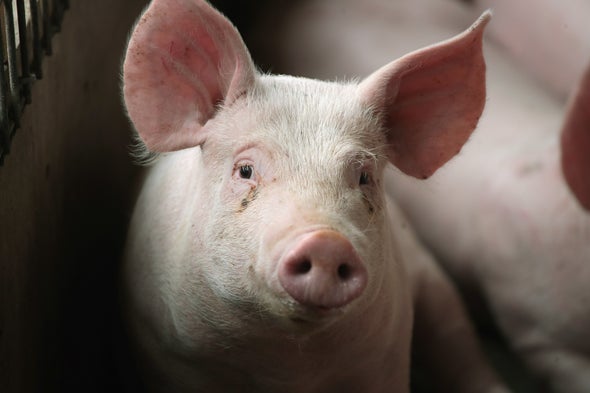
The animals affected by anthroponosis included pets such as cats and dogs, domesticated animals such as pigs, horses and cattle, birds such as chickens and ducks, primates such as chimpanzees, gorillas and howler monkeys, and other wild animals such as raccoons, the black-tufted marmoset and the African soft-furred mouse.
Wild animals in particular were much more likely to experience human-to-animal transmission than the other way around.
“This really highlights our enormous impact on the environment and the animals around us,” said Cedric Tan, a doctoral student in computational biology at the University College London Genetics Institute, lead author of the study published this week in the journal Nature Ecology & Evolution.
People and animals are hosts to innumerable microbes that can jump to another species through close contact. The study looked at viral transmissions involving all the vertebrate groups: mammals, birds, reptiles, amphibians and fish.
“Viruses can jump between different species via the same modes of transmission that apply to humans, including direct contact with infected fluids, or getting bitten by other species, amongst others,” Tan said.
“However, before a virus can jump into a new host, it must either already possess the biological toolkit, or acquire host-specific adaptations, to enter the cells of the new host species and exploit their resources,” Tan added.
Over the millennia, pandemics that have killed millions of people have been caused by pathogens such as viruses, bacteria and fungi that crossed over to people from animals. Zoonosis has been the primary concern concerning dangerous emerging infectious diseases.
“The vast majority of pathogens circulating in humans have been acquired from animals at some point in time,” said computational biologist and study co-author Francois Balloux, director of the UCL Genetics Institute.
“The current biggest threat is probably bird flu H5N1, which is circulating in wild birds. The main reason recent host jumps can be so devastating is because the population of host species has no pre-existing immunity to the novel disease,” Balloux added.
And present-day threats like the Ebola virus similarly arose from animals.
“It is largely believed that SARS-CoV-2, the agent of the COVID-19 pandemic, likely originated in horseshoe bats and jumped into humans,” Tan said.
SARS-CoV-2 outbreaks, however, also were documented during the pandemic in farmed minks infected by people.
Many species-to-species transmissions are inconsequential.
“In most cases, such infections lead nowhere, as the virus is poorly adapted and there is no onward transmission in the new host,” Balloux said.
“In some cases, the virus can start circulating, causing a disease outbreak, an epidemic, a pandemic or even establishes itself into an endemic pathogen.
Small zoonotic disease outbreaks are probably fairly common, even if we miss the vast majority of them, but full-blown epidemics tend to be rare events, evolutionary speaking,” Balloux said.
REUTERS