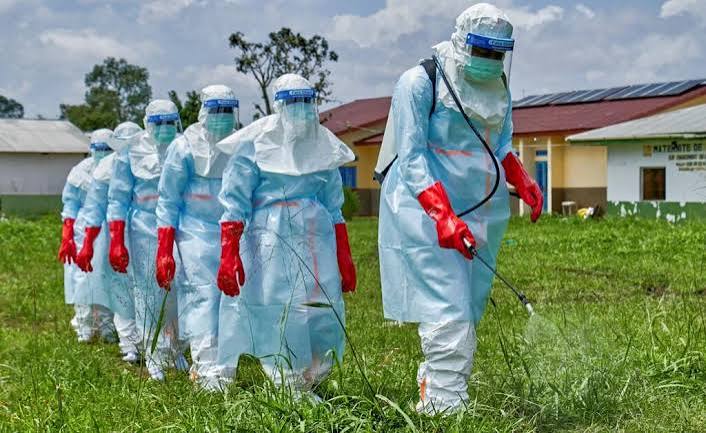
Medical officers treating Ebola
Congo, Kenya, Uganda and now Nigeria are African countries that had reported cases of Ebola with Democratic Republic of Congo (DRC) being the epicentre of the deadly disease
The Swiss foreign ministry has confirmed that a Swiss woman has contracted Ebola and brought it to Nigeria’s capital city of Abuja.
The woman said to be the wife of a Swiss employee at the embassy in Abuja is in a private clinic in Abuja, where she has been receiving treatment for her symptoms for around a week. She was diagnosed on October 20. She is thought to have contracted the virus whilst travelling to Uganda around two weeks ago.
Congo, Kenya, Uganda and now Nigeria are African countries that had reported cases of Ebola with Democratic Republic of Congo (DRC) being the epicentre of the deadly disease recording over 4,600 deaths already.
Political Economist recalls that the World Health Organization (WHO) had declared Uganda Ebola-free on August 26, 2026, following an earlier announcement by the Ministry of Health of Uganda. This, however, appears to be a false alert as the Swiss woman was said to have travelled to Uganda in late September/ early October where she contracted the Ebola virus. She did not travel to Congo as was earlier reported by a section of the media.
Her husband is currently in isolation but, according to the Swiss foreign ministry, is not showing any symptoms.
Political Economist reports that on Sunday, the World Health Organization (WHO) triggered its second-highest international alert level in response to the Ebola epidemic in the Democratic Republic of Congo (DRC), said to be caused by a variant of virus that is highly lethal and has no vaccine.
WHO’s Director-General Tedros Adhanom Ghebreyesus, had concluded that the virus “constitutes a public health emergency of international concern (PHEIC), but does not meet the criteria for a pandemic emergency”. Since 2024, the PHEIC has been the WHO’s second highest alert level, after “pandemic emergency”.
Ebola symptoms include an extremely contagious haemorrhagic fever, and remains irrepressible despite recent vaccines and treatments, which are effective only against the Zaire strain that has caused the biggest epidemics on record.
The Bundibugyo variant of Ebola, against which there is no vaccine has been causing deaths.