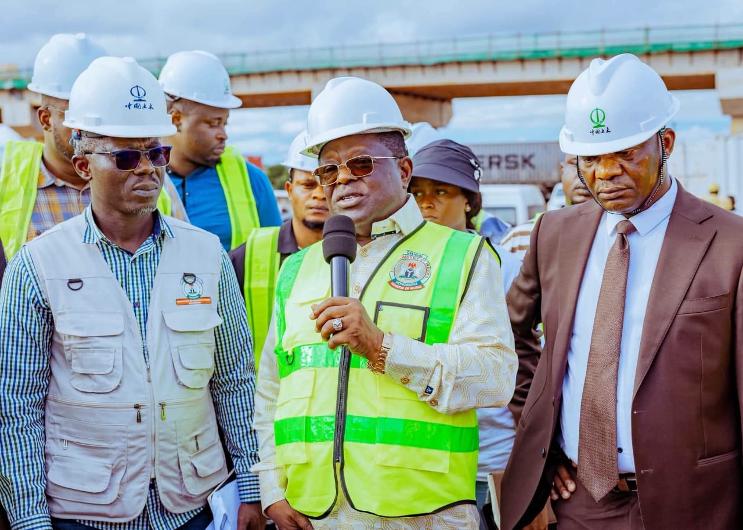
Umahi briefing the press
Umahi accused Hartland of abandoning the project after completing only about 40 per cent of the agreed scope despite pocketing N14 billion.
The Minister of Works, Engr. David Umahi, has ordered the arrest of the Managing Director of Hartland Nigeria Limited over the contractor’s failure to complete the 11-kilometre Asaba-Onitsha road project despite receiving about N14 billion.
The project covers the stretch from Summit Junction in Asaba, Delta State, to Head Bridge in Onitsha, Anambra State.
Umahi issued the directive on Thursday during an inspection of the First Niger Bridge and adjoining road projects. Furious over the contractor’s slow pace of work, he accused Hartland of abandoning the project after completing only about 40 per cent of the agreed scope.
The minister, accompanied by the Delta State Commissioner for Works (Rural Roads) and Public Information, Mr Charles Aniagwu, and senior officials of the Ministry of Works, also expressed concern over the deteriorating condition of the road and the vandalisation of critical bridge components.
He ordered ministry officials to track down and arrest Hartland’s managing director, insisting that the contractor must return to site and complete the project.
“On the Summit Junction to this Head Bridge, we gave it to the contractor called Hartland and we paid them, I think, up to N14 billion. We reached an agreement that they would finish the 11 kilometres from the Summit Junction to this bridge with the money and do the channelisation and hydraulic structures. But today, they have done just about 40 per cent of the agreement,” Umahi said.
“I am going to look for him to arrest him. Controller, you look for the MD of Hartland and arrest him.”
Umahi also ordered the ministry to recover funds paid to the contractor through the banks and directed a comprehensive review of all certificates and payments linked to the company’s projects.
He further instructed officials to immediately repair failed sections of the road around Head Bridge, warning that the poor condition of the route was worsening traffic congestion and increasing hardship for motorists.
The minister said the destruction of critical infrastructure by. Vandals had reached an alarming level, stressing that the government could not continue to spend scarce resources repairing facilities only for criminals to destroy them.
He disclosed that vandals had removed expansion joints, bolts and steel from the First Niger Bridge, including an overhead steel component vital to the structure.
According to him, the damage was more extensive than initially portrayed on social media, making urgent remedial work necessary.
Umahi ordered officials to weld damaged components that could be salvaged and replace missing steel and bolts. He also directed immediate milling and asphalt works on affected sections of the bridge.
The minister explained that the bridge’s movement or shaking did not automatically indicate structural failure, noting that bridges were designed with bearings to allow controlled movement. However, he said the heavy dead load caused by asphalt would be addressed during the repair process.
He said the government was considering restricting traffic on the bridge at night to allow repair work, with the route reopened during the day to minimise disruption.
To stop further vandalism, Umahi announced plans to install solar-powered streetlights and CCTV cameras along the bridge. He said the surveillance system would be linked to designated officials working with the police to detect suspicious activity and arrest offenders.
“We are going to have solar lights fixed all through. We are going to have CCTV here, and the CCTV is going to be downloaded to your phone. We are going to appoint people that it will be downloaded to, liaising with the police, so that if we see anybody, day and night, we can act,” he said.
Umahi urged Nigerians to protect public infrastructure, insisting that vandalism was not a political matter but a national threat requiring collective action.
He condemned the theft of iron components from concrete roads, parapets, bridges and other public facilities, describing the practice as reckless and unacceptable.
“This is not an APC problem. It is a national problem,” the minister said, warning that the Ministry of Works could not deploy personnel to every road and bridge across the country to guard against vandalism.
He also ordered ministry controllers to arrest individuals involved in illegal dredging and contractors who abandoned dangerous road sections without protecting motorists and other road users.
Umahi directed contractors handling the Asaba bypass to provide proper drainage on both sides of the road to prevent erosion and protect adjoining houses from destruction.
The minister commended Delta State Governor, Rt. Hon. Sheriff Oborevwori, for paying compensation to property owners affected by the Second Niger Bridge access road.
He said the governor’s action showed commitment to the welfare of Deltans and would help accelerate the project while easing traffic pressure in Asaba.
Umahi reaffirmed the Federal Government’s commitment to repairing the country’s critical road infrastructure despite the scale of the challenges inherited nationwide.
He warned that contractors would be held accountable and assured Nigerians that the government would take firm action to ensure public projects deliver value.
The minister also inspected a failing section around the third abutment of the Second Niger Bridge, following concerns raised by a social media user who drew the attention of the Ministry of Works to the development.
Umahi commended a social media user for bringing the issue to the ministry’s attention, saying the prompt report had enabled officials to inspect the affected portion and take steps towards addressing the problem.