Vice President Yemi Osinbajo
July 27, 2021
Transforming Africa’s food system is an obvious task requiring the active mobilization and prioritization of both public and private investments, according to Vice President Yemi Osinbajo.
This explains the resolve of the Federal Government in complementing existing development plans, sectoral strategies, and prioritizing investments in specific innovations and technologies to transform food systems in the country.
In a statement by Laolu Akande,
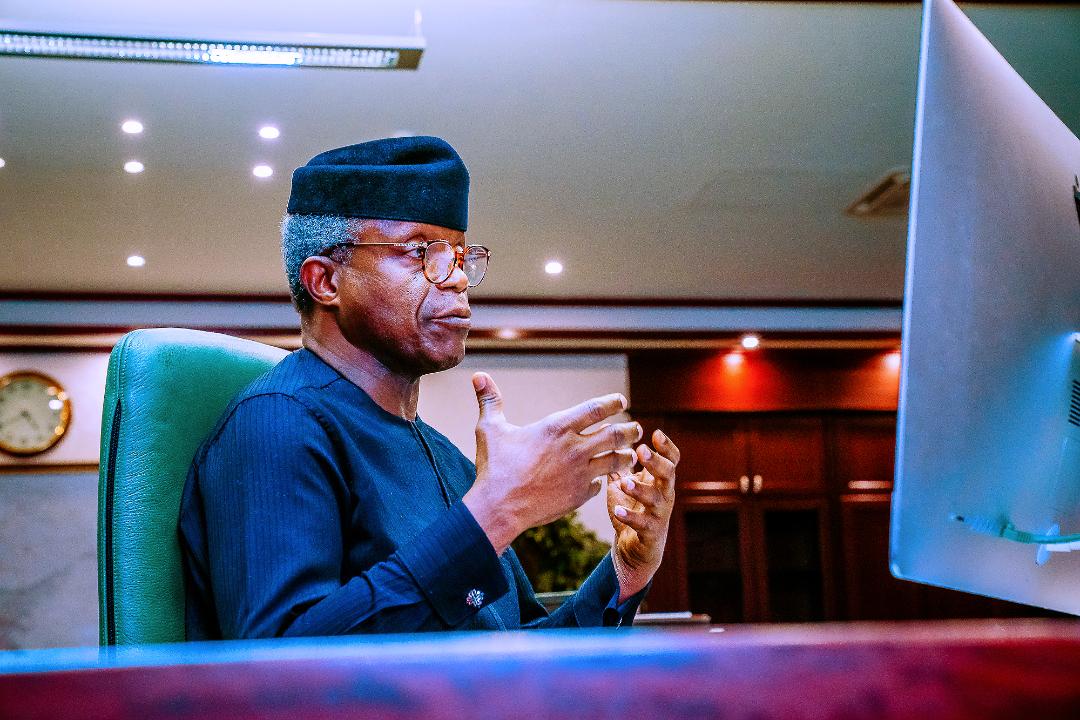
Senior Special Assistant to the President on Media & Publicity, Office of the Vice President, Osinbajo stated this on Tuesday in his remarks delivered virtually at the preparatory meeting of the United Nations Food Systems Summit 2021.
He noted that the Pre-Summit is a prelude to the culminating global event scheduled for Rome, Italy in September, 2021, an event the Vice President described as crucial just as the previous dialogues held in several countries on food systems.
Sharing insights on Nigeria’s efforts, the Vice President noted that “the Nigerian Government is committed to addressing the drivers of food insecurity such as food inflation, changing consumption patterns and climate change, amongst other things.
“At the same time and as an outcome of 40 different food systems dialogues in which up to 5,000 people participated, Nigeria is prioritizing investments in specific innovations and technologies to scale up and transform food systems.
“These actions complement existing development plans and sectoral strategies such as our Economic Recovery and Growth Plan, the National Policy on Food and Nutrition, and the National Policy on Food Safety.”
“A specific aim of our recently launched National Poverty Reduction with Growth Strategy is to address hunger, malnutrition and poverty as part of our target of lifting a hundred million Nigerians out of poverty within a decade.”
The VP explained that at the heart of Nigeria’s post-COVID-19 response is the Economic Sustainability Plan, noting that the “plan has a major component, which is the Agriculture for Food and Jobs Programme (AFJP) where we seek to leverage suitable technologies to build a resilient food system for Nigeria.”
“Our Nutrition Policy addresses the issues of sustainable and nutrition-sensitive food systems – and the country has prioritized key nutrition actions that are impactful, cost-effective, scalable, and sustainable.
“An integral part of our food systems’ transformation strategy is to create an enabling and supportive environment to implement these policies in a participatory manner involving farmers, investors and State Governments,” the VP added, assuring significant improvements in crop yields, affordable and healthy diets, among others.
Making a case for initiatives that support Africa and other developing countries, Prof. Osinbajo said, “for example, when, as in our country and several others, population growth exceeds growth in national income, food supply would not meet the needs of people, especially when distribution systems are inequitable.”
According to him, “post-harvest losses in Africa, and particularly in Nigeria, are more than 20% of production for several food groups. And this is due mainly to poor storage, poor rural infrastructure and non-automation of food processing, amongst other things.
“The situation in many African countries is given increased urgency with the impact of the COVID-19 pandemic, which has led to growing levels of acute food insecurity. This is of great concern to all of us, especially if we recall that prior to the pandemic, the prevalence of severe food insecurity was as high as 22%.”
Acknowledging the work done by Nigeria earlier in her remarks, the United Nations Deputy Secretary-General, Amina Mohammed said “let me commend the effort of my home country, Nigeria, especially the Vice President, for leading six ministers including the Minister of Finance, in the dialogues and other efforts aimed at building sustainable food systems in the country.”
“Food unites us all, as families, as communities, as cultures and as humanity, now let’s use it to unite around the urgency and the actions that are needed to transform our world by 2030,” she noted.
She added that the summit is designed to guide national governments and other stakeholders looking to leverage their food systems to support the SDGs, noting that food systems play a central role in building a fairer, more sustainable world.
Aside from VP Osinbajo and Mohammed, participants at the second day of the preparatory meeting include the Prime Minister of Italy, Mr Mario Draghi; Nigeria’s Minister of Finance, Hajiya Zainab Ahmed; Ministers representing India, Canada, China, Norway, Egypt, amongst many other countries.