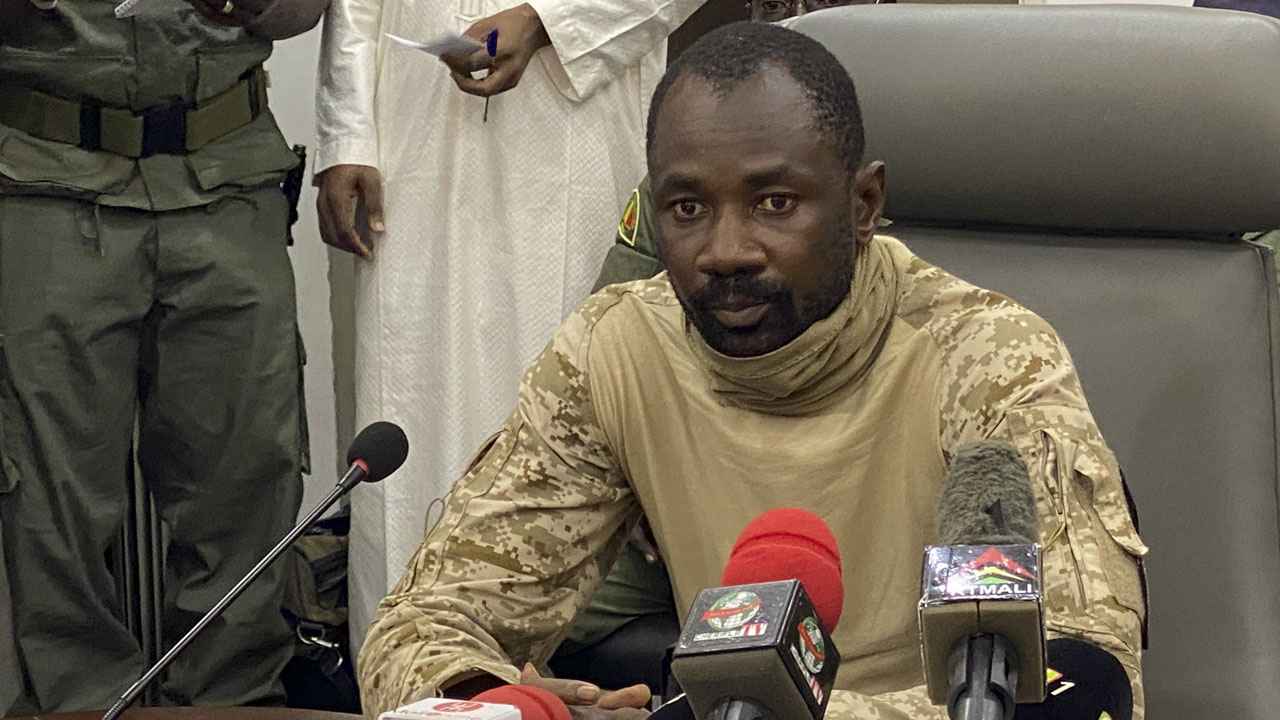
Colonel Assimi Goita speaks to the press at the Malian Ministry of Defence in Bamako, Mali, on August 19, 2020 after confirming his position as the president of the National Committee for the Salvation of the People (CNSP). – The military junta that took power in Mali on August 19, 2020, asked that the population resume “its activities” and cease “vandalism” the day after the coup that ousted President Ibrahim Boubacar Keita and his government. (Photo by MALIK KONATE / AFP)
A group of army colonels has ruled Mali since ousting President Ibrahim Boubacar Keita on Aug. 18. No consensus has yet been reached on the make-up and duration of a transitional government ahead of promised elections.
The 15-nation Economic Community of West African States (ECOWAS) is calling for a vote within a year, a timeline the junta, the National Committee for the Salvation of the People (CNSP), has not committed to.
“It is the duty of our community to assist Malians with the rapid recovery of all democratic institutions. The military junta must help us to help Mali,” ECOWAS chairman Issoufou said.
The bloc will issue a communique on the results of the summit, which is also expected to address other regional issues, including the coronavirus pandemic.

Seeking to pressure the junta, ECOWAS has already closed borders and halted financial flows amid concerns from some West African leaders the coup could undermine their power and democratic gains in the region.
Talks in the capital Bamako about the transition period got off to a bumpy start on Saturday, when supporters of the influential M5-RFP political coalition accused the junta of sidelining them.
International powers fear continued political turmoil will further destabilize Mali and undermine a joint fight against Islamist militants in the wider Sahel region.
The CNSP’s negotiations, which are also being held in regional capitals across Mali, will continue later this week.
REUTERS