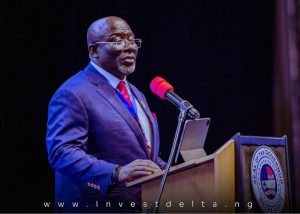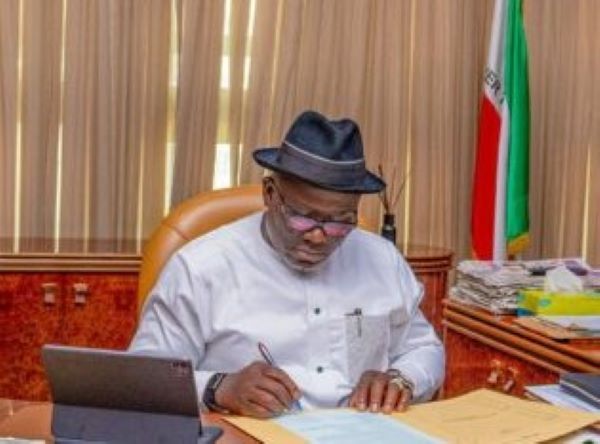
Rt Hon Sheriff Oborevwori

At inauguration on May 29, 2023, Delta governor, Rt. Hon. Sheriff Oborevwori, made a solemn pledge; to use the state’s resources for the advancement of the state. He promised to keep the ledger open, to run a government of accountability and transparency.
Barely a year and a half later, it has been promise-kept. Delta State was recently ranked among top 10 states in the 2024 Governance Accountability and Transparency Index (GATI), a project developed as an annual report, focusing on the accountability and transparency perception index of each of the 36 state governments in Nigeria. Delta is in the top bracket in good company with Lagos, Kwara, Ekiti, Anambra, Enugu, Benue, Akwa Ibom, Borno and Osun states. They were all ranked in Category A, on equal Average Index Points.
Five globally- acceptable methodologies in measuring the indices, namely: surveys; document review; expert assessments; data analysis and index aggregation were used during the state-by-state scrutiny on governance with regard to accountability and transparency.
Data released on the index explained how the rankings were arrived at. States that scored between 85% and 100% are in Category A, and rated Exceptional Performance(EP); those with 65% to 84% are in Category B, and adjudged Strong Performance (SP); 45% to 64% are in Category C (Average Performance ,AP); 25% to 44%, are in Category D (Poor Performance, PP); while 0% to 24% are in Category E (Non-Performance, NP). Delta came strong in Category A, a fulfilment of Oborevwori’s pledge to demystify governance by making every Deltan count through shared and evenly distributed resources, inclusivity and openness.
The survey was facilitated by the Guild of Online Media Editors and Publishers with a team of data analysts and verifiers spanning the media spectrum, academics, and a wide gamut of civil society organisations. The exercise is in tandem with extant global best practices where states and nations are subjected to critical reviews on their performances and efficiencies using laid down parameters verging on fiscal responsibility, resource management, application of emotional intelligence, employment generation, youth empowerment and upskilling, literacy level, inflation rate, capital to recurrent expenditure ratio, wealth-creation initiatives and internally generated revenue.
It bears re-affirming that Oborevwori has never shied away from public scrutiny of his leadership and governance under him. At every forum, he openly states the policy direction of his government, all captured in the M.O.R.E agenda. He inherited a couple of ongoing projects. He promised to complete them, bucking the noxious trend among some governors who jettison projects of their predecessors to the detriment of the people. He made the development of the Warri-Sapele once-thriving district his priority. He wants to restore the lost glory of the two cities. He promised to continue with the momentum of infrastructural development in the state. Every word he utters speaks development, not fractious politics. And step by step, he has been going about the serious business of governance of one of Nigeria’s most complex and sophisticated states.
The governor’s creed is his unwavering commitment to fiscal discipline, honesty, prudence, and transparency in governance. Oborevwori is not an accidental governor. He came prepared. His pedigree in the public ecosystem as governors’ aides at various times, then as Speaker (historically the longest serving Speaker and the only speaker who transited to the position of governor of Delta state) lends him to the tough job of managing the inherent complexities of the state. Perhaps, this explains why he’s always intentional, not compulsive, in taking certain decisions. The type and number of awards he has garnered and the high ranking of Delta among states with strict adherence to fiscal frugality and prudence attest to his personal leadership values.
By far, his strength has been his unalloyed devotion to fiscal discipline. At a recent event in Asaba on Governance and Policy Direction Conversation, themed “More Agenda: Economic Dynamics of Policy Direction, Open Governance and the Youth Inclusivity Question,” the governor, for the umpteenth time, stressed his commitment to ensuring fiscal responsibility and judicious resource allocation in completing ongoing projects, and engendering youth inclusivity in governance. Oborevwori is a youth-friendly governor and this reflects in the multi-sector empowerment of youths in the state and even in his appointments. Many of the commissioners in his cabinet are below the age of 40. The composition of the State Executive Council is an undeniable proof of his commitment to youth inclusivity in governance.
He listed elements of his M.O.R.E agenda to include policy thrusts for inclusive and sustainable economic growth, private sector-driven job creation initiatives, 21st century-compliant human capital, accelerated infrastructural development and more efficient and effective governance and accountability systems.
He believes that the starting point for good governance is instituting a regime of fiscal discipline and responsibility. This is even more germane in these times when the national economy has been impaired by crushing headwinds.
“In our current operating environment of anxiety and uncertainty occasioned by the abrupt removal of fuel subsidy and continuing devaluation of the naira, the challenge for political leaders at all levels of governance is to think outside the box and demonstrate the highest levels of discipline, honesty, prudence, and transparency in government.
“To these values we are totally and irrevocably committed, and we will do everything within our power as a government to entrench them in public administration”, Oborevwori assured Deltans.
So far, his administration has demonstrated an iron-cast resolve to ensure that public funds are judiciously applied as prioritised, first to the completion of some inherited projects and initiation of new projects all targeted at improving the quality of life of the people.
In this season when some governors have gone inert on capital projects, it is the routine to see the sprouting of mega projects in Delta with contractors working ceaselessly to meet deadlines. Whether in the far-flung riverine areas or the upland fringes of the state, there is always one project ongoing, some being commissioned. All this, coupled with huge expenditure in human capital development, welfare of workers, social security support for the underclass and improved funding for education and healthcare, are made possible by the intentional fiscal discipline of the Sheriff of Delta.
Nweze writes from Asaba