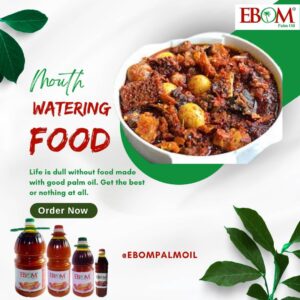

Ebom Palm oil makes better meals
Libby Offem-Oke’s inquisition on food adulteration, the obsession with cheap products, and the uncomfortable truth about what we reward in the marketplace.
Every time another report emerges about adulterated food in Nigeria, the outrage is predictable.
People are wicked!
How can anyone do this to fellow human beings?
What kind of country are we living in?
This time, it is beans reportedly laced with hazardous pesticides, palm oil coloured with harmful dyes, plantain ripened with industrial chemicals, and other everyday food products potentially exposing consumers to dangerous substances.
The outrage is justified. Food adulteration is dangerous, unethical and, where it violates the law, criminal.
But while we are busy condemning the people at the end of the supply chain, perhaps it is time to ask a more uncomfortable question;
Did we, as consumers, contribute to creating the market conditions in which these practices thrive?
Before you dismiss that question, hear me out.
The Nigerian consumer wants quality. But at what price?
We want pure food, but we want it cheap. We want products that meet regulatory standards, but we are often unwilling to pay what it costs to produce them.
We want businesses to invest in hygienic processing, quality control, appropriate packaging, product testing, regulatory compliance and proper distribution. Yet, when the compliant product arrives on the shelf at a price that reflects those investments, we complain that it is too expensive.
Then we turn around and buy a cheaper alternative without asking why the price is significantly lower.
Of course, there is another side to this argument. Many Nigerians are struggling. Food inflation, stagnant incomes and declining purchasing power mean that affordability is not a luxury; it is a necessity.
A consumer trying to feed a family on a limited income is not necessarily being unreasonable by looking for a cheaper product.
But there is a difference between being unable to afford quality and demanding that quality should cost less than it takes to produce it.
That distinction matters.
Let me bring this closer to home.
I am in the palm oil business.
At Ebom Palm Oil, we have made a conscious decision to focus on supplying pure, unadulterated palm oil. We invest in sourcing, processing, packaging and the standards required to bring a product to market that consumers can purchase with greater confidence.
But let me tell you what the business reality looks like.
You can invest in your product, put the right processes in place, package it professionally and approach supermarkets and retail outlets, only to discover that getting your product onto the shelf is one challenge, and getting paid for it is another.
Some retail arrangements operate on a Sale On Return (SOR) basis. A small business may supply products, wait for them to sell, and still have to contend with delayed payments, unsold stock and the cost of keeping the business running.
Meanwhile, expenses do not wait.
Your suppliers need to be paid. Your packaging costs money. Transportation costs money. Regulatory compliance costs money. Your staff, where you have them, must be paid.
And you still have to find customers willing to buy.
As I write this, I can look at an entire week in which I have yet to sell a single bottle of palm oil.
Think about that for a moment.
A business can do what it believes is right, invest in the quality of its product and still struggle to find a buyer.
Now imagine being a small business owner watching a cheaper, unbranded or potentially adulterated alternative move faster in the market.
What message does the marketplace appear to be sending?
That quality matters, but price matters more. That compliance is commendable, but affordability determines whether the product moves. That doing the right thing is good, but selling is what keeps the business alive.
This is where the conversation about food adulteration must become more complicated than simply calling people wicked.
Consider a trader selling palm oil.
Consumers have come to associate a deeper red colour with better quality. The trader discovers that adding a colouring agent makes the product more attractive and helps it sell faster.
Or consider the pressure to offer beans, plantain or other food products at prices customers will accept, even when safe production and handling cost more.
These examples do not justify adulteration. Nothing does.
A business owner is responsible for the choices they make. Financial pressure does not erase that responsibility.
But if consumers consistently reward appearance over authenticity, cheapness over safety, and immediate savings over reliable quality, we must acknowledge that purchasing behaviour influences the market.
When an honest business struggles to sell a properly processed product while a cheaper alternative attracts more buyers, the incentive structure is already distorted.
And when businesses learn that consumers will not pay for quality but will readily pay less for an inferior product, the temptation to cut corners can grow.
Some businesses will resist that temptation. Others will not. That is precisely why the market needs informed consumers, responsible businesses and effective regulation working together.
But are consumers really to blame?
Not entirely.
And this is where I want us to be careful.
It would be unfair to place the burden of Nigeria’s food safety crisis entirely on consumers. Many people cannot afford the more expensive option, even when they understand the difference.
Others simply do not know what they are buying. Adulterated food can look convincing, and the average consumer may not have the tools, technical knowledge or access to laboratory testing needed to identify dangerous substances.
We cannot demand that people make informed choices when they have not been given reliable information or meaningful alternatives.
There is also a regulatory responsibility. Authorities must enforce food safety standards, inspect markets, hold offenders accountable and ensure that businesses cannot gain an unfair advantage by violating the rules.
And there is a business responsibility. No company should knowingly introduce harmful substances into food simply to increase its profit or satisfy demand for a cheaper product.
The consumer may influence the market, but the person who deliberately adulterates food remains responsible for that decision.
These responsibilities are not mutually exclusive. We can hold dishonest traders accountable while also examining the purchasing culture that makes their products attractive.
We can demand stronger regulation while asking consumers to think more carefully about what they reward with their money.
And we can acknowledge the economic pressures on small businesses without excusing practices that put human lives at risk.
Dear consumer, your money is a vote. Every time you buy a product, you are making a decision about the kind of business you want to see succeed. When you consistently choose the cheapest option without considering its source, quality or safety, you may unintentionally strengthen a market in which responsible businesses struggle to compete.
When you ask why a properly packaged product costs more, that is a fair question.
But ask another one;
What does it cost to produce this product safely, package it responsibly, comply with regulations and deliver it to you?
When a product is dramatically cheaper than comparable alternatives, do not automatically assume you have found a bargain. Ask questions.
Who produced it? Where did it come from? Can the seller explain its source? Is the packaging properly labelled? Is the business accountable for what it sells?
Price matters. But price alone cannot tell you whether food is safe.
And to the consumer who genuinely cannot afford a more expensive product, this is not a call to spend money you do not have. It is a call for a marketplace where safe food is accessible, honest businesses can survive and regulators do their jobs.
We need policies and systems that make safe food affordable, not a society in which only people with deeper pockets can reasonably expect it.
We cannot shame our way out of this crisis.
If we want safer food in Nigeria, we must stop treating food adulteration as an isolated story about wicked people and begin examining the entire system that allows it to persist.
We need responsible producers. We need effective regulation. We need better education for farmers, processors, traders and consumers. We need retailers who treat small suppliers fairly. We need distribution systems that reward compliance rather than undermine it.
And we need consumers who understand that the cheapest product is not necessarily the best value.
For those of us building businesses around quality, the challenge is not simply to produce responsibly. It is to build a market in which responsible production is commercially sustainable. Because if we continue to make quality difficult to sell, we should not be surprised when quality struggles to survive.
Dear consumer, the next time you see a report about adulterated food and ask why people are so wicked, pause for a moment.
Ask yourself what you bought yesterday, why you bought it, and what informed your decision.
You may not be responsible for the adulterated food on the market. But your purchasing decisions help determine which products thrive and which businesses survive.
And that makes you part of this conversation. Not the only culprit.
But certainly not a spectator.
— Libby Offem-Oke, is the Founder, Ebom Palm Oil