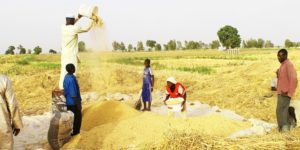
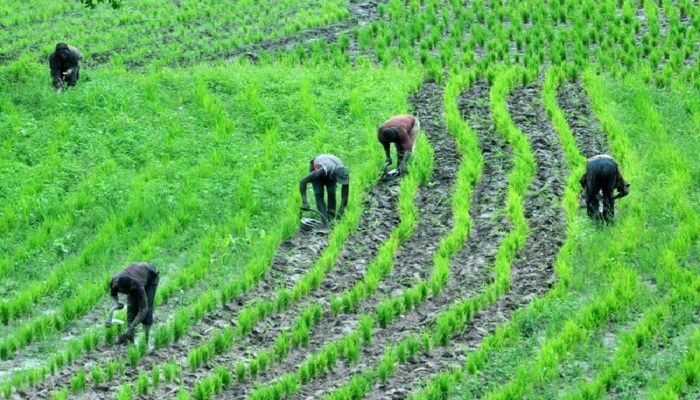
PIC.1. FARMERS WORKING ON A RICE FARM IN ZUMBA, NIGER STATE ON SUNDAY (11/9/11).

By: Agbaji Chinedu
INTRODUCTION
In many developing countries, agriculture remains in the hands of rural communities smallholders and has significant potential for long-term growth, if transformed. But for agriculture to serve as a sustainable engine of growth, there needs to be a transformation from subsistence farming systems to ones based on commercial-oriented production, this can be called mechanized farming.
The transition from subsistence agriculture to commercial-oriented production is an indispensable pathway for poverty reduction, food security enhancement, and the nutritional improvement of farm produce.
Smallholder commercialization which is associated with an increase in diversity of marketed commodities both on international and local markets , an increase in comparative advantage-based specialization on a regional and farm scale, and large-scale production and economic growth and development of the nation cannot be achieved without community cluster farming approaches, a system of communities and farmers forms clusters based on availability of land, crops comparative advantage, Off takers requirements etc. Communities donates the land with title, investors(government, donor agencies, banks or individuals) prepares the land in line with the community crop comparative advantage, Off takers lease the land and farmers in the community farms. In this case there are agreed sharing formular between the community (land owner) investor on off takers land leasing arrangement, then off takers farmers agreement based on the off takers production system.
Furthermore, in community cluster farming , it is increasingly recognized that the commercialization of small-scale farming output is closely related to higher productivity, greater specialization, and higher income at the micro-level. Moreover, at the macro level, commercialization also increases food security and, more generally, improves allocative efficiency . Therefore, commercialization is critical in the push for smallholder wealth generation, long-term growth, improved livelihoods and a food security system.
I addition, when it comes to food security system, cluster farming is key because communities are involved as a stakeholder as a result there will be access food production inputs at affordable rates such as Land, Extension services, Agro mechanization and technologies, funding and risk level is low because it has been shared within the value chain. This is the best form of inclusive farming and food system. It is also a strategic approach in creating horizontal and vertical linkage between communities, farmers and other stakeholders within agribusiness sector such as off takers, Agro producers, input dealers ( Extension Service providers) and exporters.
Once there is available prepared land in a community for cluster farming different investors will show interest in investing in the area from input to warehousing, value addition and export there by creating jobs and development.
FEATURES
- Increased productivity: Cluster farming allows for the sharing of knowledge, expertise, and resources among farmers within the cluster. This can lead to increased productivity through the adoption of modern agricultural techniques, improved irrigation systems, better access to credit and inputs, and the use of advanced machinery. By maximizing productivity, cluster farming can help meet the growing demand for food in a sustainable manner.
- Diversification and resource optimization: Within a cluster, farmers can diversify their crops and livestock based on the agro-climatic conditions of the region. This diversification helps reduce the risk of crop failure due to weather-related events or pests and diseases. Additionally, cluster farming enables the efficient use of resources such as water, fertilizers, and land. By optimizing resource utilization, farmers can produce more food with fewer inputs and minimize waste.
- Infrastructure development: Cluster farming often involves the development of infrastructure such as irrigation systems, storage facilities, processing units, and transportation networks. These infrastructure developments can improve post-harvest management, reduce food losses, and facilitate the timely movement of agricultural produce from farms to markets. Efficient infrastructure enhances the overall functioning of the agricultural value chain, benefiting both farmers and consumers.
- Knowledge sharing and capacity building: Cluster farming promotes collaboration and knowledge sharing among farmers. It provides opportunities for training programs, workshops, and demonstrations on best agricultural practices, modern technologies, and sustainable farming methods. By enhancing the knowledge and skills of farmers, cluster farming contributes to improved agricultural practices, which can lead to increased yields and better quality produce.
- Market access and value addition: By clustering farmers together, it becomes easier to aggregate produce and negotiate better prices with buyers. Cluster farming can enable farmers to collectively market their products and establish direct links with consumers, retailers, and processors. Furthermore, clustering can facilitate value addition activities such as processing, packaging, and branding, which can increase the income and profitability of farmers within their communities.
- Improved Security of Farms and Farmers: As long as the communities are involved they will do everything within their reach to protect the farms and farmers within their community cluster.
In conclusion , community cluster farming has the potential to enhance food security by promoting sustainable food system, increase productivity through mechanization, reducing post-harvest losses through value addition within the value chains (Industralization ) , strengthening market linkages. However, successful implementation requires supportive policies, investments in infrastructure, access to credit and inputs (private sector driven) , and the active participation of community/farmers, government agencies, and other stakeholders.
Agbaji Chinedu Director of Administration All farmers Association of Nigeria AFAN Writes from Abuja. 08035004617, learnder@gmail.com.