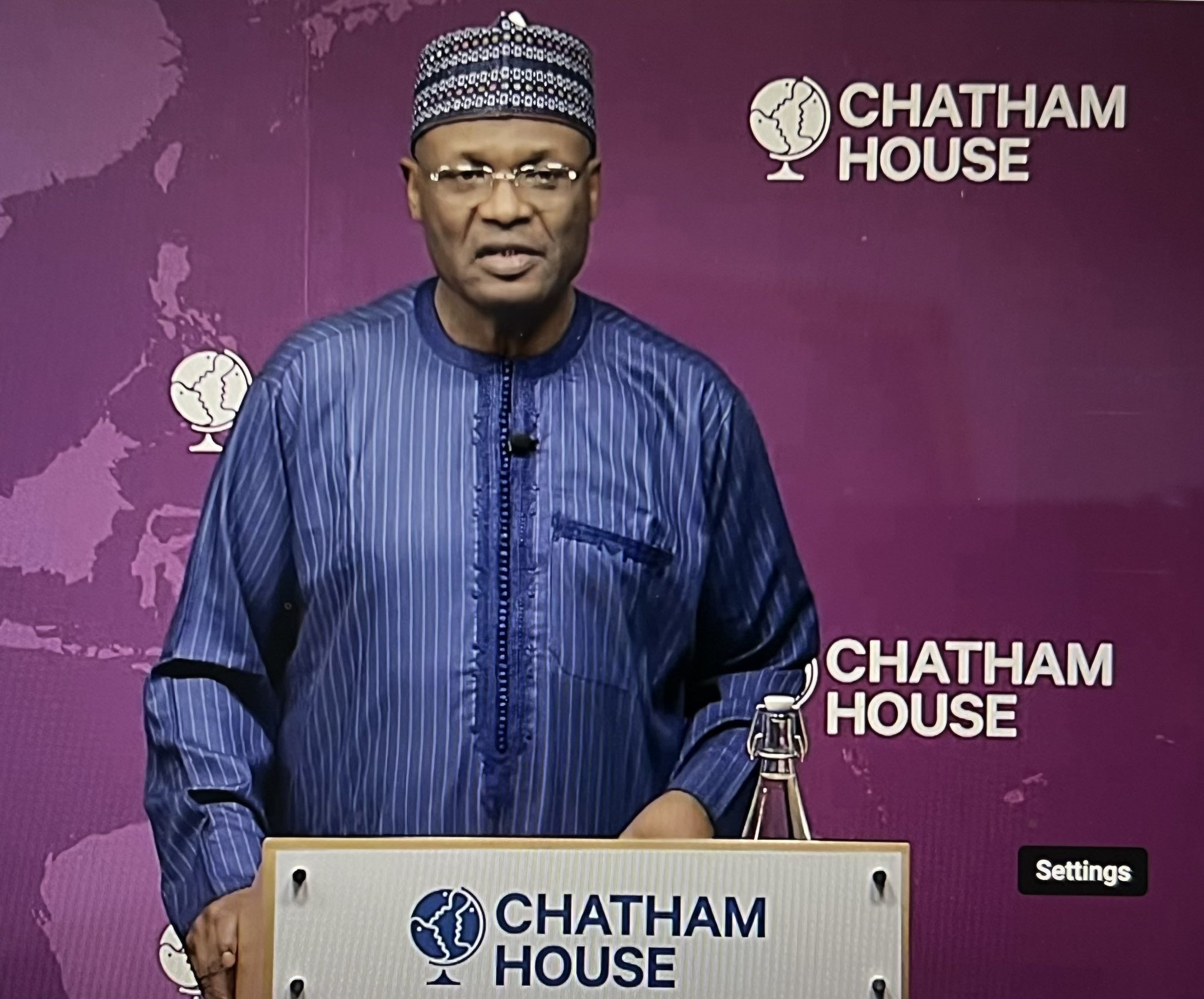
Prof Mahmood Yakubu INEC Chairman

INEC Chairman
If anyone had prophesied the retention of Mahmood Yakubu, chairman of the Independent National Electoral Commission, (INEC) in that office to which he was appointed late 2015 by Muhammadu Buhari, Nigeria’s president, beyond 2019, he would have been pilloried as a false prophet.
Yakubu, a professor of political history and international relations was on the staff of the Nigerian Defence Academy, (NDA), Kaduna before his appointment to that office. We run a country which naively confers seriousness, integrity and respectability on people, simply on the basis of their often padded and advertised curriculum vitae. Just being a professor and coming from the geo-religiously “correct” extreme of the country, privileges certain people for consideration and appointment into specific offices, and the accrual of benefits therein.
The 2019 general elections under review, spontaneously donned the regalia of Nigeria’s most controversial and contested polls in all ramifications, in recent political history. It was dogged by systemic tardiness, orchestrated disjointedness and simulated discombobulations. Electoral materials were wilfully conveyed to the wrong states and addresses, as part of a grand script for the authentication of premeditated dubiousness. Despite the mammoth mobilisation of Nigerians, many to their countryside abodes at great individual risks and costs, Mahmood Yakubu and his colleagues blatantly stage-managed the postponement of the polls by one full week. This was a rarity, even in the days of Nigeria’s earlier politics. To be sure, since I became an avid follower of Nigeria’s electoral politics back in 1979, the 2019 elections were the most treacherous and tragic I ever witnessed.
The four-year stewardship of Nigeria’s outgoing president who ran on the platform of the All Progressives Congress, (APC), had done more than enough with its gross and aggregate performance, to be determinedly denied a second term. The hydra of insecurity; crass nepotism; reinvented religious bigotry; widespread unemployment; rudderless governance; prevailing hunger, had collectively inflated and inflamed palpable anger, on the borders of gargantuan conflation. It was this level of mass disaffection which propelled Nigerians to the 2019 elections, with the belief that their permanent voter’s cards, (PVCs), will be deployed convey their collegiate disaffection and to effect the much desired political change.
Nigerians seemed to have been sold on the assurances and reassurances of Mahmood Yakubu and his team, which promised to deliver free, fair, transparent and credible elections. Mike Iginni, one of the more principled and forthcoming resident electoral commissioners, serially admonished Nigerians to keep faith with INEC. Buhari was televised warning thugs and touts who made themselves available to do the biddings of their political overlords, by snatching ballot boxes, to write their epitaphs. As Commander-in-Chief of Nigeria’s armed forces, the president had issued explicit orders to the troops to give effect to his pronouncements. Nigerians genuinely thought Buhari, whose pre-election alias in 2015, was *Baba mai gaskiya,* meaning “the honest old man,” could very truly be trusted. Buhari subsequently retired to his country abode in Daura, Katsina State, to participate in the polls. In response to a question en route Daura about what his reaction would be if he lost the election, Buhari gruffly retorted “nobody can unseat me.” He promised not to return to Abuja after the election, if he was truly trounced.
As poll results began to trickle in, however, there were vivid indications that Buhari was in for a hiding. Technology has availed us the privilege of keeping up real-time with developments across the world, from our handheld devices. Figures filtering in from across the country indicated that the scales might have been tipped in favour of Buhari’s major challenger in that election, Atiku Abubakar. Atiku, Nigeria’s Vice President in the Olusegun Obasanjo regime between 1999 and 2007, flew the flag of the major opposition party, the Peoples’ Democratic Party, (PDP), in that 2019 presidential election. Democracy was being deepened, Nigerians assumed, if a sitting president, from credible figures obtained from the server of the electoral referee, INEC, could be ousted at the ballot for a second time in four years.
Buhari hitherto, held the bragging rights to this feat, having displaced his predecessor, Goodluck Jonathan, at the 2015 elections. There were actually celebrations across the land as Nigerians absorbed the plausibility of the incumbent president’s displacement after all. The PDP had hoped for truly impartial declaration of results on the strength of its performance at the polls. The party was, however, shocked by the turn of events. Ballot boxes had seized in several places; many were stuffed with ballot papers which were previously thumb-printed. Figures had been changed with correcting fluid in several instances; electoral officers had abducted and transplanted in the homes of noveau riche political dons to serve their ends.
There had been shootings, across the country culminating in casualties, the maimed and the summarily despatched. At least in one instance, a helicopter was procured and deployed to hover over the skies of Lokoja, the Kogi State capital and to fire at voters from the skies! A new expression “inconclusive elections,” was launched into the nation’s political vocabulary. It was the APC’s terminology, borrowing from the parable of the ram which takes a few steps back, to launch out with greater ferocity. It was the party’s disingenuous formula for bidding time, albeit for a few days, for the perfection of its manual for large-scale electoral thievery. Suddenly, INEC’s acclaimed server for which billions of naira was budgeted, which was procured and duly hoisted, magically vanished!
Unknown to the APC and to INEC, the PDP operated a discrete situation room, (SR) from where it downloaded information from the very same disappearing server. The location of the SR was presumably tracked by state intelligence and severally breached by the gun-wielding operatives who repeatedly harassed and unsettled staff of the SR, impounding documents and equipment. A particular minister from the south allegedly took over the APC’s counterpoint to the PDP’s SR concept. Figures were reportedly tweaked in barefaced re-enactment of Fela Anikulapo-Kuti’s lyrics in his “Unknown Soldier” classic and, with its unforgettable refrain about “government magic,” which “turned red into blue, and the electric bulb into candlelight.” Buhari suddenly felt comfortable enough to return from his hibernation in Daura where he promised to confine himself if he lost the election. This was after industrial-scale mischief and shenanigans had been perfected in his favour.
Elsewhere, public officials who cherish their integrity and good name, who find themselves in such quandary of overwhelming malfeasance, of such sticky, messy situations, throw in the towel the morning after. By his calling as an academic and professor who was reportedly the “first northerner to earn a first class in History,” Yakubu is at liberty to choose whichever institution he prefers to serve, either at home or abroad. But not in Nigeria, where public office opens the water tap of limitless access to filthy lucre. It has been proposed that in Nigeria’s 62 year trajectory, the Buhari administration has most probably thrown up more “overnight multibillionaires” than all previous regimes put together. A former service chief has thrown his hat in the ring for the coming gubernatorial contest in Bauchi State, on the platform of the APC. A very senior principal officer in the nation’s parliament is vying for the governorship of his state in the south south zone. He reportedly whispered to some confidants that he has a private vault in excess of a dozen billion naira to prosecute the coming contest. This, regrettably, is the reality of the legacy Buhari is leaving.
If blundering public officers like Mahmood Yakubu are so bereft of shame and conscience as not to send in their letters of disengagement after such unpardonable betrayal of public trust, they get summarily fired by their employers. As has become his trademark, however, Buhari is unable to cast his search net broadly and widely, to ferret and discover better qualified Nigerians to man several government ministries, agencies and departments, (MDAs). So, rather than launch deep to unearth our contemporary Ngozi Okonjo-Iwealas, Arunma Otehs, Amina Mohammeds, Akinwumi Adesinas, Chukwuma Soludos, and so on, Buhari simply gifts Yakubu a fresh five year term! Reappointed in October 2020 in overt, maybe obvious compensation for “a job well done the previous year,” Yakubu should be in office until late 2025. Yakubu’s blighted profile, further sullied by reports of international elections observers, was not enough to restrain Buhari from further foisting his favourite son upon hapless Nigerians.
Yakubu conned Nigerians momentarily to forget his wrongdoings from the 2019 elections, as he embarked on reforms to bequeath on Nigeria, more believable, more admissible and more acceptable polls. The off-season gubernatorial elections conducted by INEC in Edo, Ekiti and more recently Osun states, demonstrated that we can do things right with requisite commitment and willpower. The innovative Bimodal Voter’s Accreditation System, (BVAS) deployed in Ekiti and Osun for instance, ensured that people’s votes truly counted. Popular investment of emotion, physical exertion and invaluable time expended by voters at the polls, were not rubbished by electoral roaches, rats and robbers. INEC had just proven that poll results from my unit in Omowa-Mopo, Isanlu, would be uploaded instantly for the world to glimpse. This revved public expectation and faith in the electoral process, to unprecedented heights.
Buhari seemed resolved to play the “born again democrat” he postured he was in those frantic days when he accepted every known ascription, to burnish his chances. As often as he could, he reiterated to Nigerians that extant shortcomings of the electoral process had been rejigged. Nigerians could go to sleep as he was resolved to bequeath a legacy of visibly honest electoral transition. Buhari enjoined Nigerians to vote for candidates of their choice at the polls, warning hoodlums to steer clear of polling zones on election day. If Buhari set out to do that which was right and proper, he faced treasonable opposition from within his party. Nasir El-Rufai of Kaduna State repeated on several television interviews he granted, that it was not Buhari’s duty to reassure Nigerians about how the elections would pan out, but to campaign for the candidate of his party. It was therefore a reluctant Buhari who got dragged around the campaign grounds of Bola Tinubu, presidential flagbearer of his candidate, presenting him to wary party supporters.
Tunde Olusunle, poet, journalist, scholar and author, is a Member of the Nigerian Guild of Editors, (NGE)