
Skip to content
July 20, 2026
  • Home
  • About us
  • Contact us
  • Newsletter
  • Privacy Policy
Political Economist

Political Economist

A liberal News reporting Politics, Sports, Business, Commentaries

  • Home
  • National News
    • Metro News
      • metro
    • Society
    • Crime and Justice
  • Special Reports
    • Investigation
    • Features
    • Interviews
  • Opinion
    • Commentaries
    • Perspectives
  • Press Releases
  • International News
  • Business & Economy
  • Politics
Watch Online
  • Home
  • National News
  • Biggest African economies lead stablecoin demand growth, study shows
  • National News

Biggest African economies lead stablecoin demand growth, study shows

Admin February 19, 2026
Africa’s biggest economies Nigeria and South Africa are driving the strongest growth in demand for stablecoins and are the most optimistic about their potential, a survey found, with many users also wanting them to become more widely accepted.
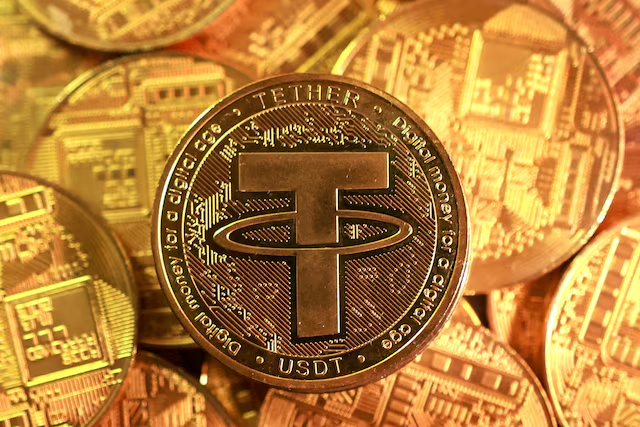
Stablecoins are promising faster and cheaper ways to move money in poorer countries, but as 99% of them, including the dominant Tether and USDC, are pegged to the dollar, they also raise worries about economic dollarisation and capital flight.
The survey, titled the Stablecoin Utility Report and conducted by YouGov with crypto firms BVNK, Coinbase and Artemis, took the views of more than 4,650 individuals from 15 countries who either hold, or plan to hold, stablecoins or cryptocurrencies.
The use of the coins today is largely for moving money between cryptocurrency markets. Nearly nine-tenths of stablecoin transactions relate to crypto trading, while just 6% are for payment of goods or services, BCG estimated in a report last year.

PREFERENCE FOR STABLECOIN PAYMENTS

The report, which also found growing demand for stablecoins in other emerging countries such as India, showed over half of those surveyed had increased stablecoin holdings in the last year, with developing economies seeing the strongest trends.
Almost 80% of Nigerian and South African respondents already held stablecoins, the figures showed, with over 75% of those also intending to increase their holdings further in the coming year.
Among non-owners, the intent to start holding stablecoins was roughly twice as high in low and middle-income economies than in high-income ones, with 95% of Nigerian respondents saying they would prefer to receive payments in stablecoins than in the Naira.
“People are already getting paid and spending stablecoins, especially where traditional payments are slow, expensive, or unreliable,” said Chris Harmse, co-founder of BVNK.
But they are also “asking for greater integration into their existing financial tools,” he added.
Stablecoin spending and desired spending

THREAT TO MONETARY POLICY

Globally, the stablecoin market is valued at more than $310 billion, dominated by U.S.-pegged tokens such as Tether ($185 billion) and USDC ($75 billion). The market is expected to expand further following U.S. regulatory moves, such as the GENIUS Act.The world’s largest cryptocurrency has fallen more than 40% from its October high, hitting its lowest level in over a year.
However, central bankers in emerging economies remain cautious. They fear stablecoins could drain domestic bank deposits, undermine monetary policy, while facilitating capital flight.
South African Reserve Bank Governor Lesetja Kganyago pointed out a potential benefit, noting remittance fees as high as $30 to send $100 to neighboring Mozambique, a gap stablecoins could help address.
The survey also highlighted limited acceptance of stablecoins in shops and online as a hurdle to broader adoption for everyday purchases and subscriptions.
REUTERS

  • Facebook
  • Share on X
  • LinkedIn
  • WhatsApp
  • Email
  • Copy Link
Tags: crypto firms BVNK stable coin YouGov

Post navigation

Previous Nigeria’s Tinubu, Germany’s Merz talk security, power deal in phone call
Next FG opens sexual assault referral centre in Abia

Related Stories

NCC Calls for African Unity to Shape Global Tech Policies Ahead of ITU 2026
  • National News

NCC Calls for African Unity to Shape Global Tech Policies Ahead of ITU 2026

July 20, 2026
FCT Police Smash Crime Syndicate, Kidnappers’ Drug Supplier Arrested, Hostage Rescued children
  • National News

FCT Police Smash Crime Syndicate, Kidnappers’ Drug Supplier Arrested, Hostage Rescued

July 20, 2026
Alleged money laundering: EFCC arraigns ex-MD Warri refinery Scammers
  • National News

Alleged money laundering: EFCC arraigns ex-MD Warri refinery

July 20, 2026
logo

Political Economist is a liberal news magazine with global affiliations.

At Political Economist, we promote free enterprise and act as a catalyst for the growth of knowledge economy. We are proudly pan-Nigeria yet richly spiced with African and global news. We offer a fair and balanced news reportage presented by our team of well-heeled professional journalists. <

About us

  • 5 Olutosin Ajayi Street, By CPM Church, Ajao Estate, Lagos State, Nigeria
  • +234 805 680 1124
  • info@politicaleconomistng.com

Follow

Subscribe to notifications

You may have missed

Wike: The standout FCT Minister in 50 years of Abuja, by Kehinde Olaosebikan 
  • Perspectives

Wike: The standout FCT Minister in 50 years of Abuja, by Kehinde Olaosebikan 

July 20, 2026
Delta North: Court rejects Ned Nwoko’s suit challenging Okowa’s candidacy Ned Nwoko
  • Crime and Justice

Delta North: Court rejects Ned Nwoko’s suit challenging Okowa’s candidacy

July 20, 2026
Why oil prices haven’t gone crazy despite 5 months of US-Iran war
  • International News

Why oil prices haven’t gone crazy despite 5 months of US-Iran war

July 20, 2026
NCC Calls for African Unity to Shape Global Tech Policies Ahead of ITU 2026
  • National News

NCC Calls for African Unity to Shape Global Tech Policies Ahead of ITU 2026

July 20, 2026
  • Home
  • About us
  • Contact us
  • Newsletter
  • Privacy Policy
Copyright © All rights reserved. | DarkNews by AF themes.