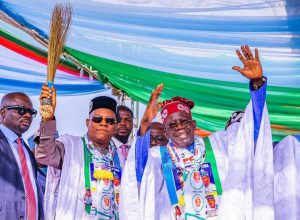

Scene from Africa Union summit recently

Unarguably, democracy and good governance go hand in hand to achieve justice and equity for the citizens.
In spite of this, observers note with concern that good governance seems to be eluding African countries, including Nigeria occasioned by endemic corruption, among other malpractices.
In a bid to remove impediments to good governance in Africa, the African Union 8th Ordinary Session of the Assembly of Heads of State and Government in 2007 adopted the African Governance Architecture (AGA) and African Charter on Democracy, Elections and Governance (ACDEG).
The motive of African leaders in adopting these documents is to stimulate adherence to the universal democratic values and principles which include respect for rule of law and human rights.
One of the objectives of the charter is to ensure that change of government is achieved through constitutional provisions.
Nigeria adopted ACDEG in 2007 and ratified it in January 2012 but it has yet to implement the charter.
A training for journalists entitled: “Mobilising Civil Society Support for the Implementation of AGA and ACDEG’’ organised by Actionaid Nigeria, a non-governmental organisation in Abuja recently was part of the steps toward ensuring implementation of the charter.
The charter has 42 provisions on virtually all the principles of democratic governance, inclusive of accountability.
It further provides that parties to the charter shall establish the necessary conditions to foster citizens’ participation, transparency, access to information, freedom of the press and accountability in the management of public affairs.
It has ample provisions on vertical and horizontal accountability measures to strengthen democracy on the continent.
One of the facilitators at the training, Mr Yusuf Shamsudeen, said that by ratifying the charter, Nigeria had expressed its willingness to implement the documents.
Shamsudeen, a Programme Officer with Centre for Democracy and Development, noted that implementation of the charter was imperative for Nigeria because the core values of its democracy were under threat.
According to him, Nigeria’s democracy is plagued by weak institutions, leadership problems, poverty, human rights abuse, corruption, unemployment and conflict, among other challenges.
“Nigeria, being a state party to the instrument, is bound to adhere to its core principles by domesticating ACDEG and AGA in the country because it stands to benefit greatly from it.
“By domestication, it means national laws should be formulated, if not available, and certain actions should be taken by the government to implement ACDEG principles in the country.
“This charter will take away the weaknesses of Nigeria’s democracy and strengthen its electoral processes, create equality, increase adherence to rule of law and human rights, among other systems.
“It will also eliminate all forms of discrimination and enhance fundamental freedom, while enhancing rights of persons with disabilities, women, minority, migrants, refugees, displaced persons and other marginalised social groups,’’ he explained.
Shamsudeen observed that the charter has all the necessary ingredients for the accomplishment of democratic accountability in Nigeria, if implemented.
He said that for the principles of ACDEG to be achieved, state parties must be committed to the provisions of the charter as stated in the framework.
“As part of the commitment, political and public sector institutions must be strengthened to deliver democratic dividends, be accountable and responsive to the needs and aspirations of the citizens.
“Also, elected government officials and public servants must see accountability as an obligation and part of the democratic rights of the citizens,’’ he said.
He insisted that civil society and the media must play their role by compelling elected and appointed government functionaries to be accountable to the people.
In this regard, Mr Tunde Aremu, a Consultant to Actionaid Nigeria, enjoined the media to effectively discharge their watchdog responsibility by holding leaders accountable in the implementation of policies, programmes and projects.
Aremu entitled his lecture at the training: “Understanding the Articles and Provisions of ACDEG and its Relevance to the Nigerian Democracy’’.
He said: “As journalists, you are the only profession that the constitution gave a responsibility to and that is to monitor the government and hold it accountable to its responsibilities, as expressly stated in Section 22 of the 1999 Constitution.
“You are to act as the watchdog of the society and ensure that the government implements agreements it signed up to, especially the ACDEG and AGA Charter’’.
He also said that journalists should highlight the socio-economic challenges confronting the people in their reportage as well as interrogate government policies and programmes with a view to engendering development and improvement in the general well-being of the people.
Participants in the training, therefore, noted that achieving this goal will require investigating governments, companies, organisations and individuals in order to uncover, present and publish reports on facts that people try to hide.
Mrs Nkechi Okoronkwo, the Acting Editor-in-Chief, News Agency of Nigeria (NAN), also presented a paper entitled: “Fundamentals of Investigative Journalism’’ in which she underscored the importance of investigative reporting.
She told the participants in the training that the job of journalists was to let people know about happenings in the society and around them.
She observed that in many cases, people in government and positions of authority attempted hiding facts.
“It is the duty of journalists to uncover these hidden facts and inform their readers or listeners accordingly.
“In many other cases, governments, companies, organisations and individuals try to hide decisions or events which affect other people.
“Such actions border on selfish motives such as corruption, compromise, misappropriation, underhand dealings, abuse and breaking the law, among others.
“People have a right to know about the society in which they live; they have a right to know about decisions which may affect them, even if people in power want to keep them secret,’’ she said.
Okoronkwo said that people in power, whether in government, the world of commerce, or any other group in the society could also abuse power, be corrupt, steal money, break laws and do all sorts of things which harm other people or they might just be incompetent and unable to do their jobs properly.
“Such people would usually try to keep this knowledge secret and it behoves journalists to expose such abuses.
“It is also the responsibility of the media to watch how well people in power do their jobs, especially those elected into public offices,’’ she advised.
Okoronkwo, therefore, urged journalists to constantly ask whether such people were keeping their election promises and if not, they should be exposed.
She urged the media to be diligent in its duty, respect the ethics of the profession, fact-check their reports and present only the truth to the public.
According to her, when the media discharges its duties effectively and efficiently, the government will sit up, the rule of law will be upheld, policies will be diligently be implemented and the nation will be better off.
In his remark, Mr Arome Agenyi, the Campaign and Advocacy Officer of Actionaid Nigeria, said: “ACDEG and AGA are developed to assist African countries to achieve the Sustainable Development Goals.
He also said that the training was organised to enlighten journalists about the charter and equip them to communicate the importance of the charter to the government and the general public through the publication of reports on the principles of ACDEG.
He said that effective implementation of ACDEG objectives could be achieved only if conscious efforts were made to promote comprehensive ratification and domestication of ACDEG across the continent.
All in all, participants in the training called for the implementation of ACDEG to address the critical challenges plaguing African nations such as corruption, lack of accountability, disrespect for rule of law and human rights abuses, among others. (NANFeatures)
- A News Analysis by Angela Atabo, News Agency of Nigeria (NAN)