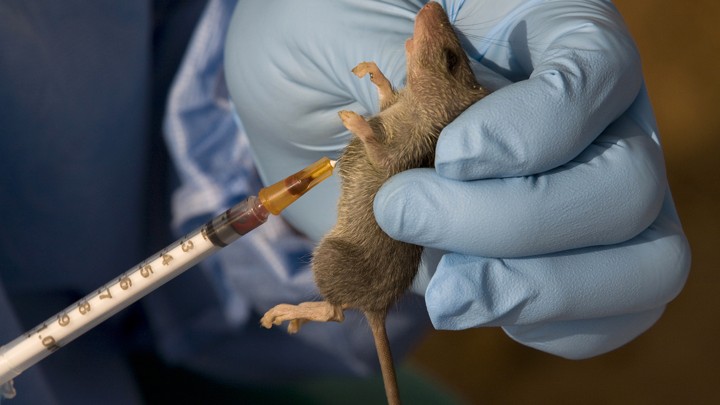
An ecologist extracts a sample of blood from a Mastomys Natalensis rodent in the village of Jormu in southeastern Sierra Leone February 8, 2011. Lassa fever, named after the Nigerian town where it was first identified in 1969, is among a U.S. list of "category A" diseases -- deemed to have the potential for major public health impact -- alongside anthrax and botulism. The disease is carried by the Mastomys Natalensis rodent, found across sub-Saharan Africa and often eaten as a source of protein. It infects an estimated 300,000-500,000 people each year, and kills about 5,000. Picture taken February 8, 2011. To match Reuters-Feature BIOTERROR-AFRICA/ REUTERS/Simon Akam (SIERRA LEONE - Tags: HEALTH SOCIETY ANIMALS) - GM1E72F07HC01
This is according to the figures given by the Acting Commissioner for Health in the State, Dr Jibayo Adeyeye, who also disclosed that COVID-19 deaths stand at 31.
Adeyeye gave the figures in Ondo town while hosting a team from the National Centre for Disease Control (NCDC) at the University of Medical Sciences Teaching Hospital.

The team was in the hospital to inspect the ongoing Molecular Biology Laboratory and the new isolation centre.
The Acting Commissioner for Health noted that less than two per cent of COVID-19 patients in the state died, while 27 per cent of those infected with Lassa fever lost their lives.
He emphasised that the government could not afford to pay much attention to COVID-19, neglecting other health problems peculiar to the state.
Adeyeye revealed that governor Oluwarotimi Akeredolu gave the directive that the laboratory should be put in place in order to effectively combat any Infectious disease occurring in the state.