
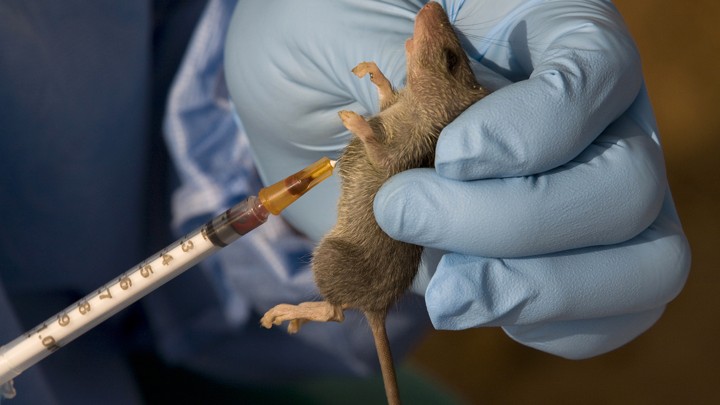
An ecologist extracts a sample of blood from a Mastomys Natalensis rodent in the village of Jormu in southeastern Sierra Leone February 8, 2011. Lassa fever, named after the Nigerian town where it was first identified in 1969, is among a U.S. list of "category A" diseases -- deemed to have the potential for major public health impact -- alongside anthrax and botulism. The disease is carried by the Mastomys Natalensis rodent, found across sub-Saharan Africa and often eaten as a source of protein. It infects an estimated 300,000-500,000 people each year, and kills about 5,000. Picture taken February 8, 2011. To match Reuters-Feature BIOTERROR-AFRICA/ REUTERS/Simon Akam (SIERRA LEONE - Tags: HEALTH SOCIETY ANIMALS) - GM1E72F07HC01
January 23, 2023
Dr. Olatunji Nasir, the President of Common Wealth Veterinary Association (CVA), says about 75 per cent of all human ailments come from animals.
Nasir made the submission on Monday in Ilorin during his paper presentation, entitled: “Veterinarians in the Face of Global Health Security”.
He was speaking on the sidelines of the 4th Induction/Oath Taking Ceremony of the 2020/2021 Graduating Class of the University of Ilorin.
The expert on animal diseases stated that the importance of Veterinary practice cannot be over emphasised, adding that they are the gatekeepers who keep diseases away from humans.
According to him, veterinarians are the interface of the environment who control advent of animal diseases encroaching into humans habitation.
Nasir postulated that there is need for collaboration between all the health sectors under the World Health Concepts, especially human and animals.
He lamented that the frequent encroachment of humans on animal habitation is a cause for concern, adding that this cause displacement of animals from their habitation.
“The wild lives and humans are interacting, as humans continually push into animals space. This interaction causes importation of diseases into human lives,” he said.
He listed some of these diseases to include Ebola, Lassa Fever, Bird Flu, Monkey Pox and the recent COVID-19 pandemic ravaging the world.
Nasir advised the new Veterinary doctors to use technology for potential changes in the profession.
He also advised government at all tiers to employ more veterinary doctors to man affairs in the agro allied industries.
The expert observed that increasing population is posing danger, hence the need for government to control the population.
Besides, Nasir enjoined herders to prevent their cattle and animals from defecating in rivers and ponds for the health of the citizenry. (NAN)