Akinwumi Adesina

By Umar Sani
Nigeria is at a crucial juncture in its political and economic journey. Once buoyed by the promise of post-colonial growth, the country now grapples with poverty, inflation, and public dissatisfaction.
A recent World Bank report highlights the severity of the crisis: over 56% of Nigerians approximately 129 million people live below the national poverty line, a staggering increase from 40.1% in 2018. Urban poverty has doubled, inflation exceeds 30%, and while structural reforms have been well-intentioned, they have often intensified hardships.
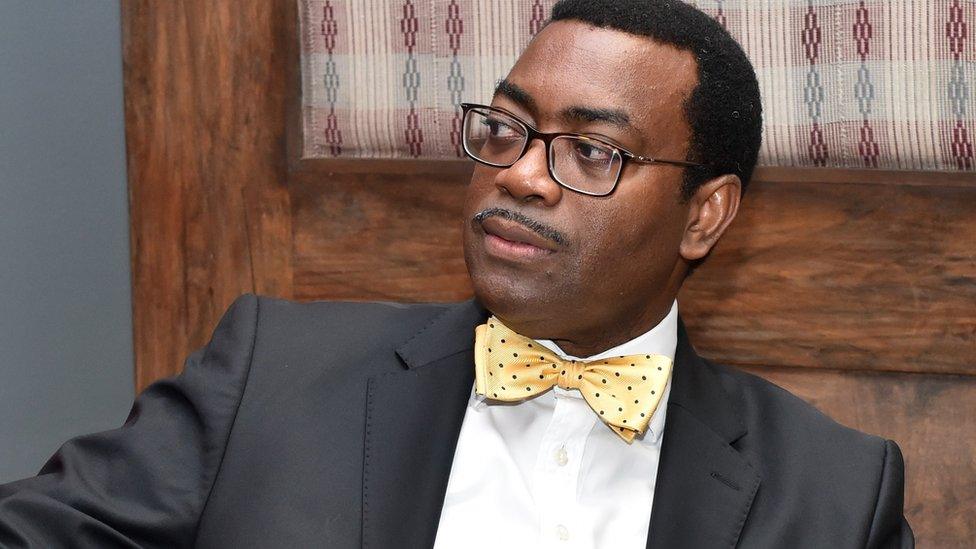
In this climate of uncertainty, Dr. Akinwumi Adesina, President of the African Development Bank, made remarks that compared today’s economic challenges with those of the 1960s. With clarity and empirical depth, he noted that real GDP per capita has plummeted from $1,847 at independence to just $824 today a reality that underscores Nigeria’s regression despite its abundant resources. He attributed this decline to decades of weak institutions, policy missteps, and chronic underinvestment in essential public goods.
Adesina’s analysis was not a political attack; it was a data-driven assessment grounded in the realities faced by millions of Nigerians. His comments strongly resonated with the World Bank’s statistics indicating that rural poverty now exceeds 75%. Projections suggest that Nigeria, despite being one of the world’s resource-rich nations, faces one of the steepest uphill battles against poverty.
In response, the Presidency, through Bayo Onanuga, quickly dismissed Adesina’s figures as “inaccurate” and “narrow,” citing a GDP per capita of just $93 in 1960 to counter his comparison. However, this rebuttal not only relied on outdated or inconsistent data but also deflected from a broader truth: Nigeria’s quality of life, institutional coherence, and social infrastructure were demonstrably stronger in the immediate post-independence era than they are today.
This rebuttal reflects a troubling trend in Nigerian public discourse, where defensiveness and political loyalty often overshadow facts. Rejection of the symptoms does not change the underlying condition, akin to ignoring a medical diagnosis. As the proverb states, “Raising your voice cannot make a deaf person hear.”
Amid this contention, HURIWA emerged as a vital voice of reason and solidarity. Standing firmly behind Adesina, HURIWA criticized the Presidency’s response as “unwarranted, disrespectful, and indicative of a broader refusal to engage honestly with Nigeria’s realities.” The organization commended Adesina not only for his statistical rigor but also for his moral clarity in articulating the hardship faced by ordinary Nigerians.
HURIWA’s support underscores the idea that truth-telling is a civic duty rather than merely a political act. By defending Adesina, HURIWA highlighted the importance of expert analysis in policymaking and reaffirmed that challenging authority with facts is a hallmark of democratic engagement, not an act of treason.
The organization emphasized the need for a candid reckoning. Adesina’s intervention was a call for strategic change, not a censure. The facts he presented demand an accompanying policy shift one that combines prudent macroeconomic reform with intentional investments in job creation, education, health, and institutional integrity. This framework must also include robust social protections to support the most vulnerable during economic transitions.
The core of Adesina’s clarion call was about Nigeria rising, elevating itself from deepening and widespread poverty, and achieving a much faster pace of economic growth. Adesina is not someone to ignore. His outstanding leadership and achievements at the African Development Bank and the ingenuity of his innovative ideas have earned him the trust of Presidents and leaders around the continent and globally. His very thoughtful speech (for anyone who actually reads it, is unbiassed and dispassionate) is actually solutions oriented, forward looking and very pragmatic on what Nigeria should be in 2050.
The Presidency should not politicise the patriotic assessment of Adesina, which if taken seriously has the potential to set Nigeria on a faster pace of economic growth and prosperity. As Adesina said, it is time to turn Nigeria into a developed economy. How can that be wrong and missed in the raging rush to smear his well-intentioned push?
Interestingly, Onanuga forgot that in the same speech Adesina’s patriotism as a Nigerian comes out strongly as he helped to mobilise $2.9 billion to support the development of special agro-industrial processing zones for 28 States in Nigeria, all in support of the same Presidency that is pillorying him? Few weeks ago when Adesina was in Nigeria, he launched the groundbreaking of the first set of 8 special agro-industrial processing zones, together with Vice President Kashim Shettima and Governors of Kaduna State and Cross Rivers State, all APC controlled States. Adesina does not play politics. He is a serious minded, selfless and patriotic Nigerian who works relentlessly and passionately with everyone to advance the economic progress of Nigeria.
Nigeria cannot achieve long-term growth through selective amnesia. It requires a willingness to confront painful truths and to recalibrate governance accordingly. As Adesina has made clear, acknowledging decline is not an act of defeat but the first step toward renewal.
In defending Adesina, HURIWA reminded the nation that public officials owe citizens more than dismissive rebuttals; they owe accountability. Their intervention helped steer the national dialogue back to what truly matters: the lived experiences of millions, the credibility of national data, and the moral imperative to respond with empathy and evidence-based policies.
History will judge not only those who spoke but also those who listened. Whether Nigeria chooses to embrace truth as the foundation for recovery or continues to disguise the crisis with noise will ultimately shape its legacy for generations to come.