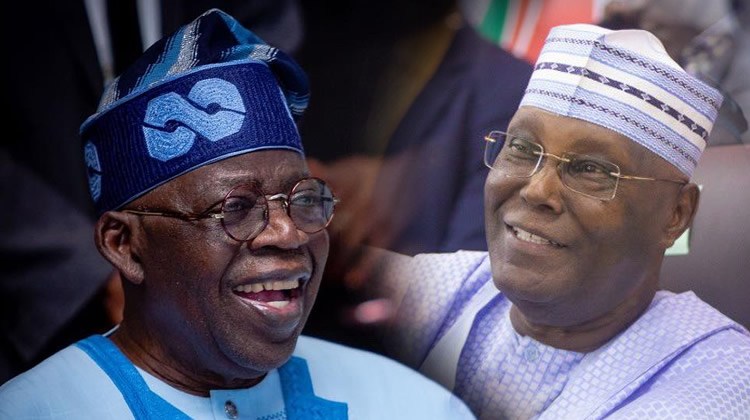
Tinubu and Atiku

I read a recent report in Reuters titled: Argentina’s market double down on Milei as investors ‘start to believe’.
I took a keen interest in reading the report because I know quite well that Argentina and Nigeria closed the last quarter of the year 2023 on a similar path of economic downturn.
In the case of Nigeria, a new government was installed at or about the middle of 2023, for Argentina, the new government came on board in December.
Both leaders inherited a disoriented economy, but both applied different measures to recovery.
President Javier Milei of Argentina was sworn into office on 10 December 2023. He inherited a worse condition than Nigeria’s.
But what he did to return his country to a place where investors are ‘starting to believe’ should serve as a lesson to Nigeria’s Bola Tinubu.
Nigeria is where we are today simply because of what Tinubu has done or did not do.
His shifting the blame on the opposition and, even ridiculously, his predecessor is needless and myopic. Market forces don’t play politics. They respond to your actions and inactions.
President Milei’s major campaign promise was to reposition the Argentine economy after years of slow growth, high debt levels, triple-digit inflation (160% when he took over the Presidency in December 2023) and 40% poverty rate.
His first task was to begin implementing measures to achieve greater macroeconomic stability and promote higher global competitiveness.
He came into the office with a comprehensive stabilization plan, which seeks to implement far-reaching measures within the context of a market-oriented economy.
He started off cutting government expenditure by cutting the size of government and wastages; blocked stealing of government funds, and attracted Foreign Direct Investment (FDI) through concessions, tax holidays, and improved ease of doing business.
President Milei flies regular business class for all his travels and does not offer the presidential fleet of Argentina for his son’s birthday.
Likewise, there is no settlement for his hangers-on and political allies through unwieldy and burdensome appointments to public offices.
Argentina’s Milei did not build the largest government like Tinubu did at a time when our economy was and still on its knees.
The examples set by President Milei are the requirement of leadership in a time when the economy has begun to fail the expectations of the people.
The reforms so far implemented by the Tinubu administration are ad hoc and hurriedly put together without proper review. Ours is unlike Argentina’s Milei, who is sequencing his reforms.
President Milei anticipates the after-reform shocks and admits that things will be tough for the people. But he is fully prepared for the aftershocks and has in place mitigating pills.
He walks the talk. He makes sacrifices himself by giving up perks of office.
It is not business-as-usual for the presidency while the people are called upon to make sacrifices.
Argentina runs a lean government by reducing the number of ministries, privatizing nearly 40 state-owned enterprises, and reducing wasteful spending.
Conversely, Tinubu in Nigeria increased the number of ministers and ministries and is spending enormous resources renovating houses for himself, his deputy, and the first lady.
That is nothing short of Nero playing fiddle while Rome is on fire!
Worse still, Tinubu has refused to roll up his sleeves and do the work that he signed up for. Instead, he and his team are preoccupied with behaving like Napoleon and Squealer, characters in the satire book Animal Farm, who made it a state policy scapegoating Snowball (the opposition) for their own failures arising from their ill-advised policies.
I am attracted to the reforms in Argentina because Javier Milei’s stabilization plan bears a similar emblem with my Recover Nigeria Plan.
It is a plan that I am more than willing to disclose details of its workings with the current government in order to take Nigeria out of the depth of hunger and anger that we find ourselves in.
Hide quoted text
The plan includes strategic steps we must take to recover the economy and make it stronger, dynamic, resilient, and competitive.
We had outlined plans to relax the fiscal constraints facing us to include:
• Improving Spending Efficiency and Blocking Leakages
• Saving money through:
a. A review of fiscal support for non-performing government enterprises and the privatization of those that can not sustain themselves.
b. Steps to improve spending efficiency through a gradual reduction in government recurrent expenditures, ensuring that those expenditures reflect higher levels of service delivery. Over the medium term, recurrent expenditures should not exceed 45% of the budget.
c. A review of government procurement processes to ensure high levels of transparency, competitiveness, and value-for-money and eliminate all leakages.
Unless, and until there are clear-cut policies and pathway to economic rejuvenation predicated on a leadership led sacrifice, there will be discontentment, especially among the youths, which may find expression in protests and for which it will be silly to continue to blame the opposition for.
Atiku Abubakar
Vice President of Nigeria, 1999-2007
25th February, 2024.